




 New Product Development
 Custom Chocolate Formulations
 Quality Assurance
 Turnkey Chocolate Manufacturing
 Production at Scale
 Private Label
 Bakery and Pastry Solutions
 Organic Chocolate
 Upcycled Cocoa Products







MANUFACTURING & PRODUCT DIFFERENTIATION
Turnkey Chocolate Manufacturing: A Compliance Guide for US and UK Brands
Outsourcing production does not outsource liability. Here is what compliance actually covers when someone else makes your chocolate — and the questions that separate a certified supplier from a defensible supply chain.
What does compliance cover in turnkey chocolate manufacturing?
|
Five things, and only one of them is a certificate. A compliant turnkey partner needs (1) a GFSI-recognised food safety system such as FSSC 22000 or BRCGS, (2) documented allergen control with validated cleaning and verification testing, (3) accredited analytical testing for cadmium, microbiology and nutritional data, (4) farm-level cocoa traceability capable of supporting deforestation due diligence, and (5) labelling review for each market you sell into. Your brand name is on the pack, so legal responsibility stays with you — what you are really buying is evidence. |
If you are a brand owner or a mid-size manufacturer weighing up a co-manufacturing partner, the compliance conversation usually arrives late and badly. It gets treated as a document request at the end of a commercial negotiation: send us your certificates, we will tick the box. That approach works right up until a retailer audit, a customs hold or a consumer complaint, at which point the gap between a certificate and a functioning system becomes expensive.
Compliance in chocolate is unusual because the risk is concentrated upstream, in an agricultural raw material grown by smallholders thousands of miles from your factory. Cadmium content, deforestation status, child labour risk, pesticide residue and the traceability record that proves any of it are all decided long before the beans reach a conche. A turnkey partner who buys cocoa on the open market and a partner who buys it from named associations are selling you very different risk profiles, whatever their certificates say.
|
The deadline moved twice. The requirement did not. The EU Deforestation Regulation has now been postponed twice — first to December 2025, then to 30 December 2026 for large and medium operators, with micro and small operators covered from 30 June 2027. Every delay has been about readiness and IT systems, never about lowering the traceability standard. Brands treating each postponement as a reprieve are losing the one thing the delays actually bought them: time to build the data. |
WHAT YOU'LL LEARN
- When turnkey manufacturing makes sense — including when you already have in-house R&D
- Which certifications matter, and what each one actually unlocks commercially
- What deforestation due diligence means if you sell in the US and the UK, not the EU
- What farm-level traceability requires in practice, and why origin choice changes the difficulty
- How US and UK labelling requirements diverge — and what is coming next in both
- How to audit allergen control beyond the certificate
- A question bank by role: R&D, procurement, quality and brand
- A pre-contract compliance checklist
1. What is turnkey chocolate manufacturing — and when does it make sense?
Turnkey chocolate manufacturing is a full-service model in which a single partner handles cocoa sourcing, formulation, pilot runs, scale-up, quality testing and finished packaging. You provide the brief and the brand; the partner delivers market-ready product.
The common framing — that turnkey is for brands with no technical capability — is wrong, and it is worth correcting because it leads teams to the wrong shortlist. Most brands that move to turnkey chocolate already have a capable product development function. What they lack is chocolate-specific process capability: tempering control, cocoa butter crystallisation, conching, particle size distribution, bloom management, and the analytical infrastructure to prove all of it batch after batch. Those are deep, narrow competencies that take years and significant capital to build in-house, and they rarely justify the investment for a brand where chocolate is one line among several.
WHICH MODEL FITS YOUR SITUATION
|
Your situation |
Likely best fit |
Why |
|---|---|---|
|
No in-house R&D, testing a new category |
Full turnkey |
Partner-led formulation and scale-up shortens time to first shelf and removes capex |
|
Strong in-house NPD, no chocolate process capability |
Co-development turnkey |
Your brief and sensory direction, partner's process engineering and pilot infrastructure |
|
Own production, need chocolate as a component |
Ingredient supply |
Couverture, drops or inclusions to your spec; you retain assembly and packing |
|
Own production, capacity or compliance gap in one market |
Hybrid |
Outsource the SKUs where the regulatory or technical burden is highest |
|
KEY INSIGHT Turnkey is a capability decision, not a capacity decision. Ask what your team genuinely cannot do rather than what it does not have time to do — the first is a partnership, the second is a staffing problem that outsourcing will not fix. |
2. Which certifications should your manufacturing partner hold?
Certifications are entry tickets, not differentiators. The useful question is not whether a partner holds one, but what each certificate unlocks for you commercially and what it explicitly does not cover.
CERTIFICATIONS — WHAT EACH ONE ACTUALLY UNLOCKS
|
Certification |
What it covers |
What it unlocks |
|---|---|---|
|
FSSC 22000 |
GFSI-recognised food safety management system built on ISO 22000 plus sector prerequisites |
Baseline for most US and international retail and foodservice accounts |
|
BRCGS Food Safety |
Product safety, food safety culture, traceability and operational controls, graded audit |
Frequently mandated by UK supermarkets for own-label supply |
|
HACCP |
Hazard analysis and critical control points — the foundation the above are built on |
Regulatory baseline; on its own, rarely sufficient for retail |
|
Organic (USDA / EU–UK) |
Certified inputs and segregated handling |
Organic claims; note US and UK schemes require separate certification |
|
Kosher / Halal |
Ingredient and process conformity under religious authority |
Specific retail channels and export markets |
|
Non-GMO |
Verified absence of bioengineered inputs |
Positioning in US natural and premium channels |
|
B Corp |
Verified performance across governance, workers, community, environment and customers |
Credible substantiation for company-level responsibility claims |
Two things to check that most buyers miss. First, scope: a certificate covers named product categories and named sites. A partner certified for couverture is not automatically certified for filled and enrobed formats. Second, audit grade and date: BRCGS issues grades, and an AA at a recent unannounced audit is a materially different signal from a C at an announced one. Ask for the certificate, the scope statement and the grade together.
|
ACTIONABLE TIPS
|
3. Deforestation due diligence: what applies if you sell in the US and the UK?
This is where most compliance guides mislead brands selling outside the EU. The EU Deforestation Regulation is the strictest regime in force, but it is not the one that governs a UK or US brand by default — and assuming it does, or assuming nothing applies, are both costly mistakes.
DEFORESTATION REGIMES AFFECTING COCOA — STATUS AS OF SEPTEMBER 2026
|
Market |
Regime |
Status |
What it requires |
|---|---|---|---|
|
EU |
EUDR (Reg. 2023/1115, amended 2025/2650) |
In force; applies from 30 Dec 2026 (large and medium operators) and 30 Jun 2027 (micro and small) |
Proof that cocoa was not grown on land deforested after 31 Dec 2020, with plot-level geolocation and a due diligence statement |
|
UK |
Forest Risk Commodities, Schedule 17, Environment Act 2021 |
Primary legislation passed; implementing regulations announced June 2026, consultation and parliamentary time still pending |
Expected to prohibit use of commodities produced on illegally deforested land, with a due diligence system and annual reporting for in-scope businesses |
|
US |
No federal equivalent in force |
Legislative proposals tabled without passing; no mandatory due diligence regime |
Obligations arise from retailer requirements, investor commitments and advertising law on substantiating claims |
Two practical consequences follow. If you sell in the UK, the regime is coming but its thresholds and timings are not yet fixed — which makes it a supplier-selection question now rather than a compliance project later. And if you sell only in the US, no law compels traceability, but your retail customers increasingly do, and any deforestation-free or sustainably sourced claim on pack has to be substantiated under advertising and consumer protection law regardless.
|
KEY INSIGHT The three regimes differ in timing and legal force, but converge on the same underlying capability: knowing which plot your cocoa came from. Build to the strictest standard and you satisfy all three — build to the minimum and you rebuild every time a market moves. |
4. What does farm-level traceability actually require?
Traceability is easy to claim and difficult to build. Under EUDR, a due diligence statement must carry geolocation coordinates for the plots where the cocoa was produced, the production date and evidence of deforestation-free status, submitted through the EU information system before goods are placed on the market. Records must be retained and can be audited, and false declarations carry real penalties. The 2025 amendment simplified who submits — the first operator placing product on the EU market carries the full statement, rather than every downstream actor — but it did not simplify the data itself.
That data does not appear at the factory gate. It comes from long-term relationships with farming organisations, polygon mapping of plots, and a digital record that survives aggregation through cooperatives and regional buyers. A supply chain assembled from spot-market purchases cannot produce it retroactively.
|
Origin matters more than most buyers assume. Traceability difficulty is not uniform across cocoa origins. Where beans pass through many undocumented intermediaries before export, plot-level attribution is close to impossible without rebuilding the chain. Where a manufacturer buys directly from named associations in a single origin, the record exists because the relationship exists. Ask a prospective partner not whether they have traceability, but what percentage of their volume they can attribute to plot level — and to see the evidence for your specific product. |
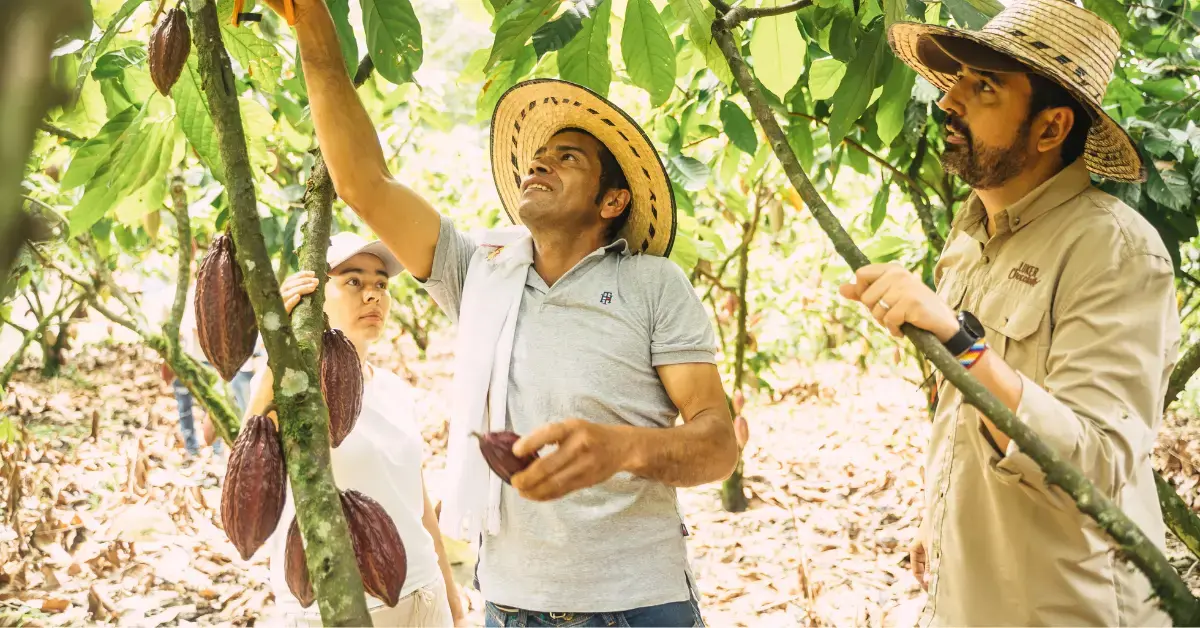
Luker Chocolate's model is built around this: Fine Flavour Cocoa bought through 84 farmer associations and 73 regional buyers, with roughly 63% traceability coverage overall and 100% for volumes destined for the EU. About 90% of the London stock price is payed to farmers. The point is not the numbers in isolation — it is that they are auditable, and that a brand can put them in front of a retailer.
|
[PLACEHOLDER — quote from Quality or Sustainability lead on why traceability has to be built at the relationship level, not the documentation level. Needs approval before publishing.] — LUKER CHOCOLATE |
|
ACTIONABLE TIPS
|
5. How do US and UK labelling requirements differ?
Every market requires an accurate ingredient list, allergen declaration, nutritional information and net weight. The divergence is in format, emphasis and what is coming next — and it is the reason dual-market brands often end up with market-specific artwork rather than a single global pack.
US VS UK LABELLING — PRACTICAL DIFFERENCES
|
Element |
United States |
United Kingdom |
|---|---|---|
|
Framework |
FDA food labelling regulations |
Retained EU Regulation 1169/2011, administered domestically post-Brexit |
|
Allergen declaration |
Within the ingredient list or a separate "Contains" statement immediately following; sesame is a declarable major allergen |
Emphasised within the ingredient list, typically in bold |
|
Nutrition panel |
Nutrition Facts panel, per serving, US formats and units |
Per 100 g table, optionally per portion |
|
Front of pack |
Proposed mandatory "Nutrition Info" box (saturated fat, sodium, added sugars, Low/Medium/High) — proposed rule not yet finalised |
Voluntary traffic-light scheme widely adopted by retailers |
|
Promotion constraints |
No federal HFSS-equivalent restrictions |
HFSS volume-price promotion restrictions in force in England since October 2025; paid online advertising restrictions enforceable since January 2026 |
The UK HFSS rules are the underestimated one. They do not change what you can put on a label, but they change what you can do with the product commercially — multibuy mechanics and paid digital advertising for in-scope products are closed off, and whether a product is in scope is determined by the nutrient profiling model. That moves a nutritional question directly into formulation and portioning decisions, which is precisely where a turnkey partner should be involved early rather than after artwork is signed off.
|
KEY INSIGHT Labelling compliance is a downstream symptom of a formulation decision. A pack that has to carry an unfavourable front-of-pack descriptor, or a SKU that falls into HFSS scope, was determined at the recipe stage — months before anyone opened the artwork file. |
|
ACTIONABLE TIPS
|
6. How should a partner handle allergen control?
Chocolate is a high-risk category for cross-contact. Milk, tree nuts, soy and wheat routinely share lines with cocoa, and precautionary labelling is a commercial cost as much as a safety measure: a "may contain" statement closes off free-from channels and a meaningful segment of shoppers.
Robust control has three layers. Segregation: dedicated storage, marked equipment and production scheduling that runs allergen-containing products at the end of a cycle. Validated cleaning: documented procedures proven to remove residue, not simply performed. Verification: routine swab testing of equipment surfaces and finished-product testing on sensitive batches, with results from an accredited laboratory.
That last layer is where accredited in-house testing changes the economics. Luker operates one of the few laboratories in Latam accredited by ONAC for cadmium determination, salmonella detection and lactose protein content, which means verification results are recognised internationally without duplicate testing — relevant both for allergen verification and for the cadmium limits that apply to cocoa products in several markets.
|
ACTIONABLE TIPS
|
7. Substantiating sustainability claims without greenwashing
Sustainability claims now carry legal exposure in both target markets. Regulators and advertising authorities on both sides of the Atlantic have moved against vague environmental language, and "sustainable", "eco-friendly" and "responsibly sourced" all require evidence proportionate to the impression they create.
The safe structure is specific, verifiable and scoped. "Cocoa traced to farmer associations in Colombia" is defensible because it is checkable. "Sustainable chocolate" is not, because it claims everything and evidences nothing. Third-party certification helps, but note what each one covers: organic certifies inputs, fair trade schemes certify price and premium mechanisms, B Corp certifies company-level performance. None of them substantiates a product-level environmental claim on its own.
|
KEY INSIGHT Working with a certified partner does not transfer their certification to your product. A B Corp manufacturer allows you to describe your supply partner accurately; it does not make your product certified. Write claims about what you can evidence, at the level you can evidence it. |
8. How do you audit a manufacturer's compliance capability?
Certificates tell you a system existed on audit day. A facility visit tells you whether it operates. Look at ingredient storage conditions, the state of documentation at each station, and whether line operators can explain their own quality responsibilities without referring to a manager. Ask about recall history and past incidents — a clean record shows discipline, a handled incident shows capability, and a defensive non-answer tells you the most.
Because turnkey decisions are made by a committee, it helps to divide the question bank by who is asking.
QUESTION BANK BY ROLE
|
Role |
What to ask |
|---|---|
|
R&D / NPD |
What pilot-scale infrastructure exists, and what are the scale-up protocols between pilot and commercial batch? Who owns formulations developed jointly? |
|
Quality / Technical |
Certificate scope and audit grades; cleaning validation and swab records; laboratory accreditation scope; corrective action history |
|
Procurement |
Sourcing model and supplier qualification; traceability percentage at plot level; minimum order quantities; lead times and capacity headroom for growth |
|
Brand / Commercial |
What claims can be substantiated with evidence you can share with retailers? What origin story is documented and verifiable? |
|
Legal |
Confidentiality terms; IP ownership of co-developed recipes; incident notification and recall support obligations; record retention |
|
ACTIONABLE TIPS
|
Pre-contract compliance checklist
- Certificates obtained with scope statements and audit grades, verified against public registers.
- Certification scope confirmed for your specific product format, not just the site.
- Traceability demonstrated against a real batch, with plot-level coverage stated as a percentage.
- Deforestation position mapped for every market you sell into, including markets you plan to enter.
- Allergen controls verified through cleaning validation and swab records.
- Laboratory accreditation scope checked against your destination markets' testing requirements.
- Nutrient profiling run on candidate formulations before sensory sign-off.
- Artwork review responsibility assigned contractually, before print.
- IP ownership, confidentiality and incident notification agreed in writing.
- Capacity headroom confirmed against your three-year forecast, not your current volume.
Compliance in turnkey chocolate manufacturing is not a folder of certificates; it is the evidence trail behind them. The brands that navigate this well treat supplier selection as the compliance decision — because once the contract is signed, you inherit whatever supply chain your partner built, and you carry the liability for it under your own name.
Frequently asked questions
What certifications should a turnkey chocolate manufacturer hold?
FSSC 22000 or BRCGS as the GFSI-recognised food safety baseline, underpinned by HACCP. Add organic, kosher, halal or Non-GMO according to your positioning and market. Always check the certificate's scope covers your specific product format and the audit grade, not just that a certificate exists.
Does EUDR apply to a UK or US brand?
Not directly, unless you place product on the EU market or export to it. UK brands will be covered by the Forest Risk Commodities regime under Schedule 17 of the Environment Act 2021, with implementing regulations announced in June 2026 but not yet in force. The US has no federal equivalent; obligations there come from retailers and from claim substantiation law.
When does EUDR actually start applying?
30 December 2026 for large and medium operators, and 30 June 2027 for micro and small operators, following a second one-year postponement confirmed in December 2025. The 2020 deforestation cut-off date and the geolocation requirements were not changed by the delay.
Who is legally responsible if a private-label product fails compliance?
The brand whose name appears on the pack. Outsourcing manufacture does not transfer legal responsibility for labelling accuracy, claim substantiation or product safety. That is why supplier qualification, artwork review terms and incident notification clauses matter more in private label than in any other model.
How long does it take to develop a new chocolate product through turnkey manufacturing?
Standard formulations typically reach production within a few months. Products requiring custom ingredients, extensive stability testing or novel formats generally take a quarter. Build in additional time for packaging development and regulatory artwork review, which are frequently the critical path rather than the recipe.
What minimum order quantities apply?
MOQs vary with product complexity and whether the formulation is standard or bespoke. Luker's typical minimum is 4 metric tonnes. Custom developments requiring dedicated runs usually sit higher. Confirm MOQ alongside lead time and capacity headroom, as the three together determine whether a partner can support your growth.
Can turnkey manufacturing produce allergen-free products?
Yes, where the manufacturer operates allergen-controlled or dedicated lines with validated cleaning and verification testing. For free-from positioning, confirm line dedication contractually rather than relying on production scheduling, and check that verification testing is performed by an accredited laboratory.
Sources you can visit
- Council of the EU — targeted revision postponing the EUDR
- European Commission, Access2Markets — EUDR delay and implementation developments
- legislation.gov.uk — Environment Act 2021, forest risk commodities
- FDA — front-of-package nutrition labelling
- GOV.UK — HFSS promotion and placement implementation guidance
|
Compliance is built upstream The hardest parts of chocolate compliance — plot-level traceability, accredited verification testing, defensible origin claims — are decided by how cocoa is bought, years before a product brief exists. Luker's B4B model is built on direct relationships with Colombian farmer associations and on evidence brands can hand straight to a retailer. Talk to our team about your compliance requirements. |