




 New Product Development
 Custom Chocolate Formulations
 Quality Assurance

 Turnkey Chocolate Manufacturing
 Production at Scale
 Private Label
 Bakery and Pastry Solutions
 Organic Chocolate
 Upcycled Cocoa Products





|
Quick answer: Three forces are reshaping the bakery and pastry brief going into 2027. Indulgence is becoming more sensory and more intentional: texture, layers, and single-portion formats are rising, while large, occasional treats are losing ground. Health is being added to indulgence rather than subtracted from it, with protein, fibre, and gut-friendly formulations now the fastest-growing positionings in the launch pipeline. And familiar flavours (chocolate above all) remain the anchor, with innovation happening around them rather than instead of them. The trends fading in 2026 include viral hybrid pastries, freeze-dried confectionery and novelty-first launches. These formats have lost momentum in social conversation; this alone does not establish whether they have become habitual purchases. |
Table of contents:
-
Which bakery and pastry trends from 2026 are losing momentum?
- How to translate the trend map into an NPD innovation pipeline
Which bakery and pastry trends from 2026 are here to stay?
Not every direction fades at the end of a trend cycle. Some become baseline — the expectations consumers now bring to every category instead of a reason to buy a specific product. Three directions from 2026 fall into this category.
Multisensory indulgence as the baseline, not the differentiator
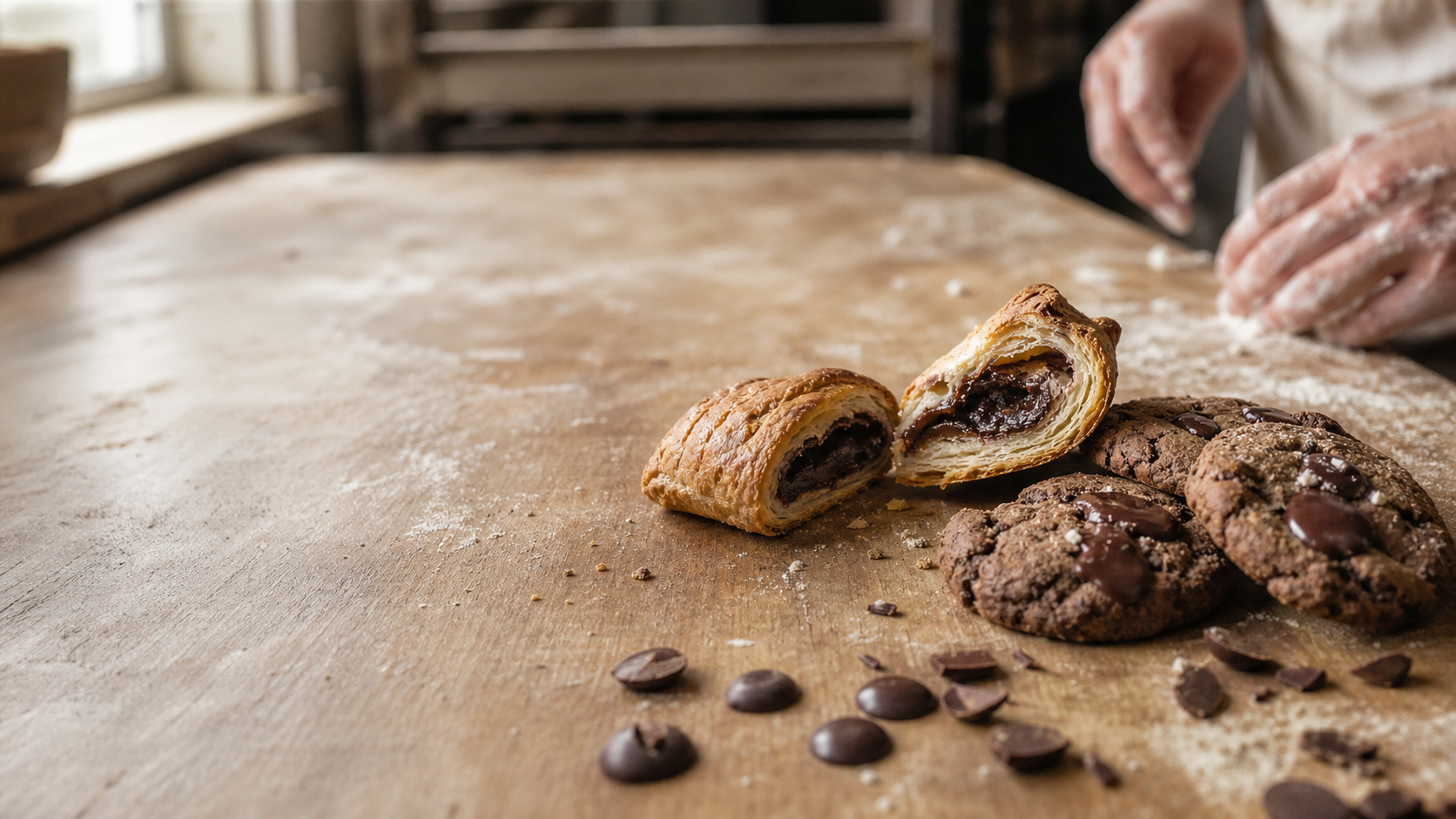
Texture, layering, visible fillings and contrast have moved from innovation hook to table stakes in premium bakery. 57% of consumers globally seek interesting texture combinations when indulging, and that figure holds across both the UK (52%) and the US (46%) (Innova Market Insights, 2026d). Chocolate-filled bakery launches grew by 12% year on year in 2026 — a signal that fillings are no longer a differentiator in themselves, but a baseline expectation of what "indulgent" means.
For 2027, this means brands can't win on "we added a filling" alone. The question becomes which filling, in what format, and how the bite architecture is designed.
Smaller-format indulgence replacing larger-occasion treats
56% of consumers now prefer having smaller treats more frequently to having larger treats occasionally — a structural shift that reshapes everything from portion sizing to packaging to shelf placement (Innova Market Insights, 2026c). 54% of consumers also say they treat themselves spontaneously, without planning, which further reinforces the single-serve, grab-and-go format over the planned-dessert format.
This isn't a passing preference. It aligns with the broader "GLP-1 effect" on consumer basket composition (smaller portions, more selectivity) and with the generational shift towards "intentional indulgence" that Innova flags as a 2027 direction.
Functional benefit added to indulgence, not substituted for it
Health in bakery in 2026 stopped meaning "sugar removed" and started meaning "benefit added." Over 2 in 5 consumers globally now prefer sweet biscuits and cookies with added health benefits (Innova Market Insights, 2026b). In the UK, sweet biscuit launches carrying ‘high protein’ or ‘source of protein’ claims accounted for 3.2% of category launches by 2025, growing at a CAGR of 21% between 2021 and 2025, while no-added-sugar launches grew at a CAGR of 73% over the same period (Innova Market Insights, 2025).
The direction is settled. For 2027, the open question is which benefits consumers reward most — and the fastest signals in the US launch pipeline point to weight management, prebiotics and gut health as the three positionings worth watching.
Key insight: These three directions are no longer where differentiation happens. They're where qualification happens — the minimum a product needs to clear before it gets evaluated on anything else.
>Download our PDF with the 2026 Bakery Insights and 2027 Outlook<
Which bakery and pastry trends from 2026 are losing momentum?
Social media creates visibility for formats and flavours faster than it creates habits. Several 2026 launches that generated significant conversation have already lost momentum heading into 2027.
Viral hybrid pastries
The crookie, flat croissant and other viral pastry hybrids have lost momentum in social conversation during 2026. Crookie conversation fell by 43.6% year on year and flat croissant conversation fell by 40.7% (Tastewise, 2026). The decline in conversation suggests that launch attention can fade quickly. Whether these formats become category staples requires evidence of repeat purchasing, not social attention alone.
Novelty-first confectionery
Freeze-dried confectionery conversation fell by 51% year on year, and cannabis-adjacent confectionery categories (CBD, THC, terpenes) have declined by between 30% and 54% (Tastewise, 2026). These declines indicate reduced social attention, not necessarily weaker sales or lower repeat purchasing.
Trend-driven ingredient positioning
Plant-based milk as an ingredient callout fell by 41% year on year in bakery conversation, and textured vegetable protein in bakery fell by 35% (Tastewise, 2026). The ingredients themselves haven't disappeared from formulations — they've simply stopped being used as marketing hooks. This matches a broader 2026 pattern of consumers rewarding what a product delivers (texture, protein content, taste) over what it signals (plant-based, clean-label, free-from).
Actionable tip: When reviewing a 2027 NPD pipeline, test whether a hero concept has repeatable eating occasions attached. Formats that only work as a "try it once" moment will likely follow the pattern of the fading 2026 viral launches.
>Download our PDF with the 2026 Bakery Insights and 2027 Outlook<What's coming in 2027 bakery and pastry NPD
Three directions are building momentum in the launch and consumer-research data for 2027. None are entirely new — all are evolutions of what's already present — but each is moving fast enough that it deserves its own line in the brief.
Sensory architecture becomes the design unit
If multisensory indulgence is the 2026 baseline, "sensory architecture" is the 2027 direction. Innova's 2027 forecast places sensory-driven innovation among its top ten directions globally, with specific emphasis on unusual texture combinations (interesting to 56% of consumers), aroma and visual appeal as decision triggers before the first bite (FoodNavigator, 2026; Baking Business, 2026).
For bakery, this translates into deliberately designed bite architecture — crunchy-plus-soft, creamy-plus-crispy, gooey centres, visible fillings and layered formats — where the bite itself becomes part of the innovation, not just the flavour.
Metabolic positioning moves into bakery
Innova's 2027 "metabolic shift" trend sits at the intersection of GLP-1-shaped consumer behaviour, blood-sugar awareness and satiety-focused positioning. Bakery is directly in its path. Expect more products positioned around steady energy, satiety and blood-sugar impact, often paired with protein, fibre or alternative sweeteners that align with that narrative.
The fastest-moving US launch positionings — weight management, prebiotic, gut health — all sit inside this direction. The 2027 opportunity isn't to pick one; it's to identify which combination makes sense for a specific brand's audience.
"Safe discovery" as the flavour innovation pattern
Chocolate remains the anchor in both US and UK bakery launches, but the fastest growth is happening around the core, not within it. In the US, fruit-flavoured bakery launches grew at a CAGR of 30% between September 2024 and September 2026; nut-flavoured launches grew by 20%. In the UK, cake-inspired, cookie-inspired and pie-inspired flavour profiles grew at a CAGR of 29%. Dessert-inspired profiles, fruit-plus-chocolate pairings and nut-forward formulations are the directions where novelty is being accepted.
The underlying consumer pattern: 46% of consumers globally say they go for the same option when they indulge — but they'll accept novelty when it builds outward from a flavour they already trust. This is "safe discovery" as a design principle, not a limitation.
Key insight: The three 2027 directions aren't competing with each other. The strongest 2027 launches will combine them — a sensory-architecture bite, built around a familiar flavour anchor, carrying a metabolic benefit as an added layer.
>Download our PDF with the 2026 Bakery Insights and 2027 Outlook<
Where chocolate fits in the 2027 bakery innovation map
Chocolate's role in bakery changes very little as the trend map evolves — but how it's used does.
In 2027, chocolate is less likely to be the sole headline flavour and more likely to be the anchor that lets a brand do something more adventurous around it. A chocolate-fruit pairing, a chocolate-nut format, a chocolate filling in a protein-forward base, a chocolate inclusion in a fibre-rich recipe — each takes advantage of the "familiar anchor + novel layer" pattern that bakery innovation is settling into.
For formulators, this has practical implications:
- Chocolate quality becomes more important as it carries less of the headline on its own. A great chocolate inside a protein cookie needs to taste like great chocolate, not like a compromise.
- Format compatibility matters more. Fillings, inclusions, drops, enrobing — the chocolate needs to behave correctly in the specific bakery format it's integrated into.
- Sugar reduction in the chocolate component becomes relevant when the bakery product is positioned around a metabolic benefit. The whole product has to tell a coherent story.

How to translate the trend map into an NPD innovation pipeline
A trend map is only useful if it changes what sits in the development pipeline. Three practical actions for 2027 brief-setting:
Actionable tip: Audit the current pipeline against the "staying" directions first. If a brief doesn't clear the baseline on indulgent sensory experience, functional benefit or portion compatibility, it's being evaluated against a 2024 bar.
Actionable tip: Separate "launch moment" ideas from "repeatable occasion" ideas. The decline in social attention around 2026 viral pastries highlights the need to assess repeat-purchase potential separately from launch excitement. 2027 pipelines should balance a small number of attention-driving launches with a larger base of repeatable-habit products.
Actionable tip: Build in flexibility between US and UK formulations. The data shows the same macro directions in both markets, but the pace and specific sub-trends differ (functional protein moves faster in the US; no-added-sugar moves faster in the UK). A single global formulation may be the harder path.
Key takeaway: The 2027 bakery and pastry brief isn't about any single trend. It's about how brands combine the directions that are now baseline (sensory indulgence, functional benefit, portion flexibility) with the directions that are rising (sensory architecture, metabolic positioning, safe discovery) — while deliberately avoiding the formats and positionings that have already peaked. Chocolate remains the connective tissue in both markets.
FAQs
What are the biggest bakery trends in 2027?
Three directions dominate the 2027 bakery and pastry forecast: sensory architecture (deliberately designed texture, layering and format combinations), metabolic positioning (products built around steady energy, satiety and blood-sugar impact), and "safe discovery" flavour innovation (novelty built outward from familiar anchors like chocolate, fruit and nuts).
Which 2026 bakery trends are already fading?
Viral hybrid pastries like the crookie and flat croissant have lost significant conversation share year on year. Freeze-dried confectionery, cannabis-adjacent confectionery categories, and plant-based ingredient callouts as marketing hooks are also declining. The common pattern is declining social attention around novelty-led formats and ingredient messaging; purchase data would be needed to establish whether repeat purchasing has also declined.
Is chocolate still the leading bakery flavour in 2027?
Chocolate enters 2027 as the leading bakery launch flavour in both the US (23.76% share) and the UK (34.33% share), based on Innova data from September 2024 to September 2026. The fastest-growing adjacent categories are fruit, nuts and dessert-inspired profiles — innovations typically paired with chocolate rather than replacing it.
What functional ingredients are driving bakery innovation in 2027?
Protein (whey, milk, plant-based), fibre, prebiotics, and ingredients supporting gut health are moving fastest in both US and UK launch pipelines. UK protein launches in sweet biscuits grew at a CAGR of 21% between 2021 and 2025; US positionings around weight management (+37%), prebiotic (+36%) and digestive health (+32%) are among the fastest-growing claims.
How is GLP-1 adoption changing bakery product development?
GLP-1 medications are reshaping consumer basket behaviour — smaller portions, greater selectivity, higher sensitivity to sugar and fat density. For bakery, this reinforces the shift towards smaller-format products, protein-forward positioning and formulations that align with satiety and metabolic claims. The effect is less about losing the bakery category and more about re-sorting it towards products designed for the new basket.
Do US and UK bakery trends move at the same pace?
The macro directions are shared, but specific sub-trends move at different speeds. UK bakery is more weighted towards no-added-sugar growth and traditional dessert-inspired flavour profiles. US bakery is moving faster on protein, functional claims and dessert-adjacent novelty. A product strategy that works in both markets usually benefits from flexibility in positioning rather than a single global formulation.
Related resources:
What US Food Policy in 2026 Is Actually Changing for Chocolate NPD
5 Key Variables for Strategic Chocolate Decisions
Explore our Bakery and Pastry Solutions
References
- Baking Business. (2026). Innova 2027 trends report leads with nutrient density. https://www.bakingbusiness.com/articles/67048-innova-2027-trends-report-leads-with-nutrient-density
- FoodIngredientsFirst. (2026). Bakery trends: Industry taps functional ingredients as healthy indulgence demands rise. https://www.foodingredientsfirst.com/news/bakery-trends-functional-ingredients-healthy-indulgence.html
- FoodNavigator. (2026, October 13). The 10 food and beverage trends set to shape 2027. https://www.foodnavigator.com/Article/2026/10/13/the-10-food-and-beverage-trends-set-to-shape-2027/
- Innova Market Insights. (2025). UK sweet biscuits and cookies, 2021–2025 [Category database]. Innova Market Insights.
- Innova Market Insights. (2026a). Cookies and sweet biscuits in the US, April 2021 – March 2026 [Category database]. Innova Market Insights.
- Innova Market Insights. (2026b). Innova category survey 2026 (Average of 35 countries) [Survey report]. Innova Market Insights.
- Innova Market Insights. (2026c). Innova lifestyle and attitude survey 2026 [Survey report]. Innova Market Insights.
- Innova Market Insights. (2026d). Innova trends survey 2026 (Average of 11 countries) [Survey report]. Innova Market Insights.
- Innova Market Insights. (2026e). UK top flavours in product launches, September 2024 – September 2026 [Launch database]. Innova Market Insights.
- Innova Market Insights. (2026f). US top flavors in product launches, September 2024 – September 2026 [Launch database]. Innova Market Insights.
- Tastewise. (2026). 5 declining food trends that won't survive 2026. https://tastewise.io/blog/declining-food-trends