




 New Product Development
 Custom Chocolate Formulations
 Quality Assurance
 Turnkey Chocolate Manufacturing
 Production at Scale
 Private Label
 Bakery and Pastry Solutions
 Organic Chocolate
 Upcycled Cocoa Products














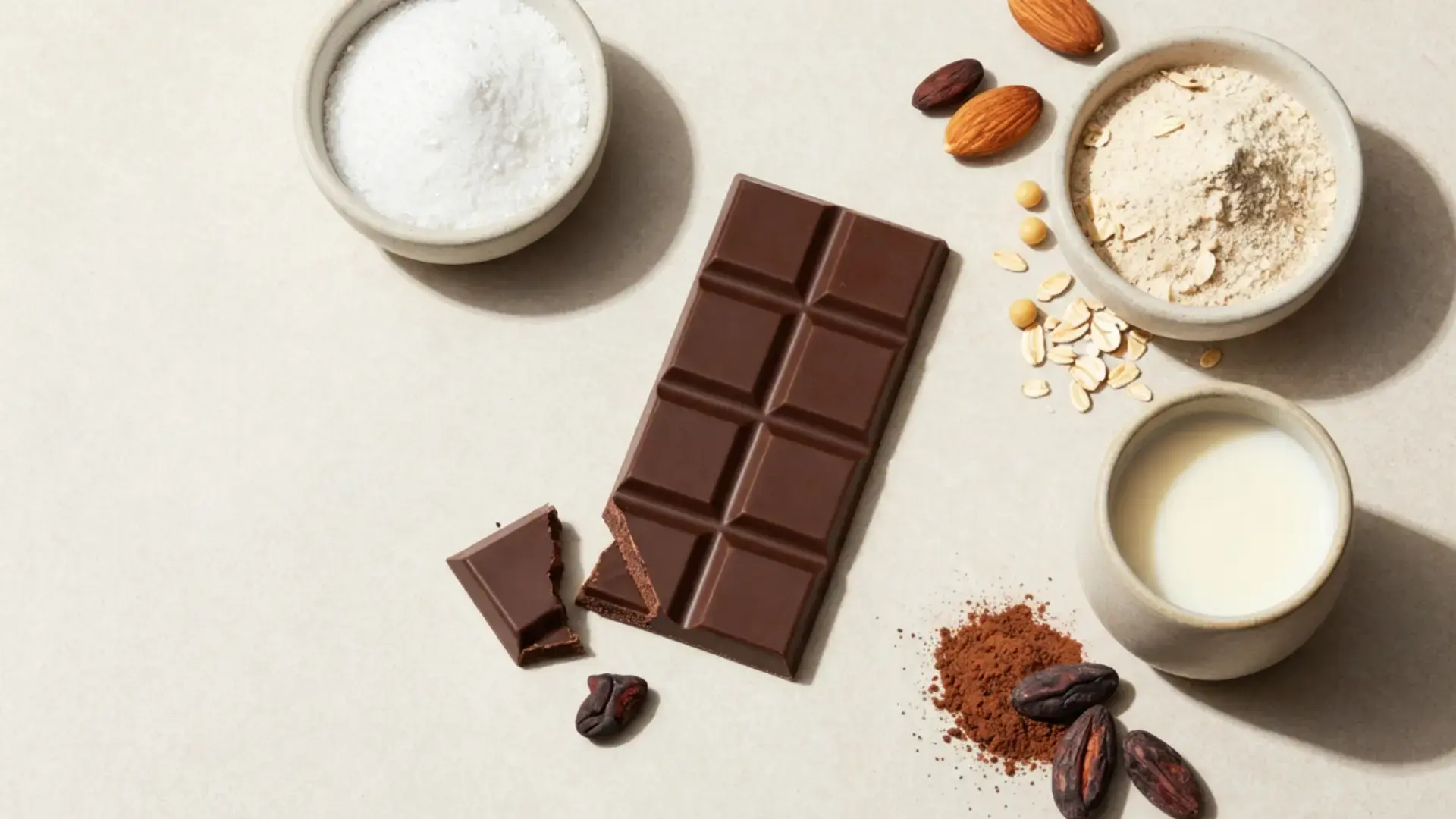
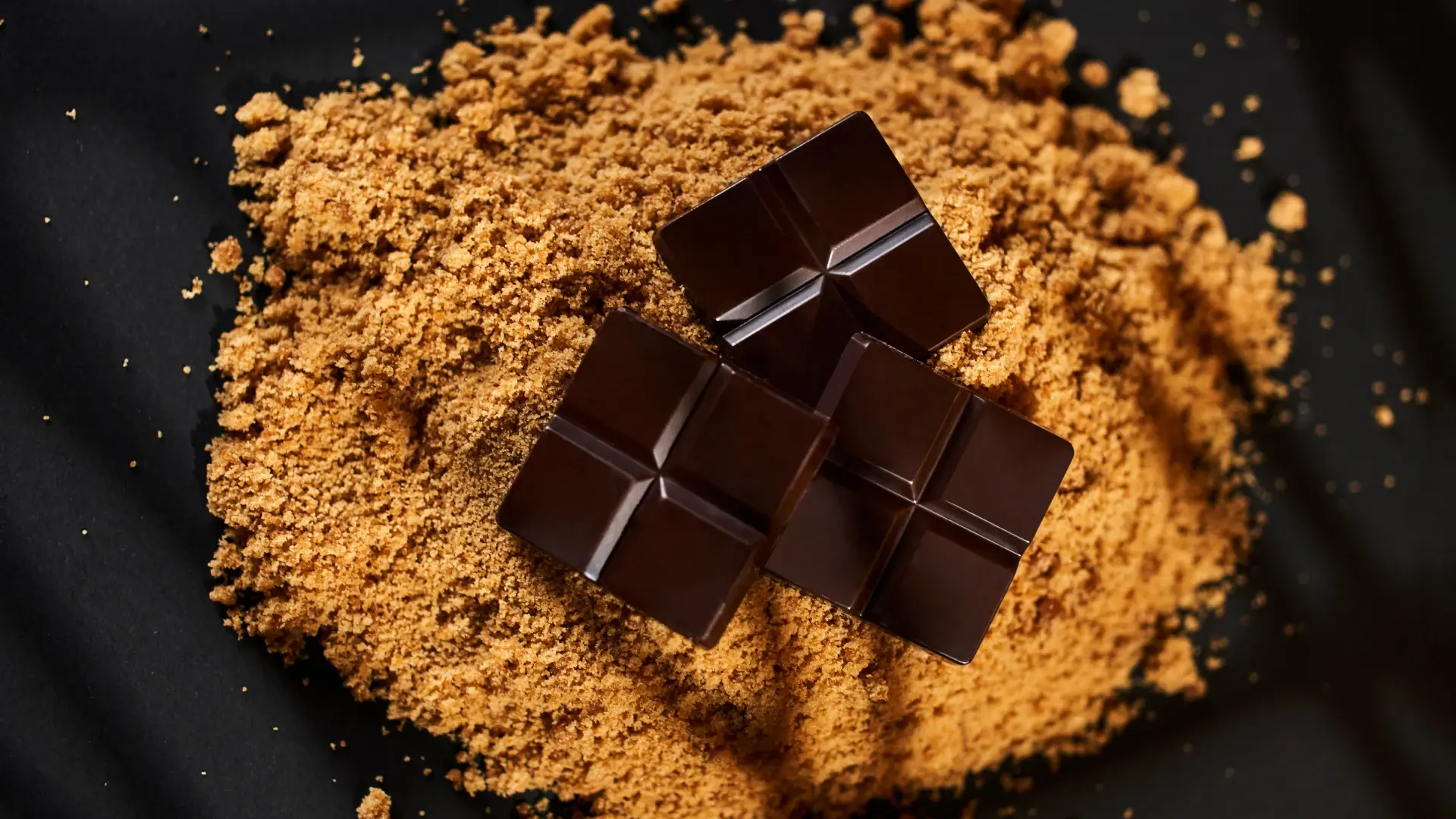
Reducing sugar in chocolate is no longer a niche request. Across confectionery, bakery, snacks, and beverages, brands are actively reformulating to meet growing expectations around health, functionality, and transparency, and better-for-you chocolate has moved from a specialist niche into mainstream ranges. But while reducing sugar may seem straightforward on paper, delivering the same sensory experience and processing performance is far more complex.
Because in chocolate and its applications, sugar is not just a sweetener—it is a structural component that influences texture, flow, stability, and shelf life.
What is the best way to reduce sugar in chocolate formulations?The most effective approach is to combine high-intensity sweeteners, bulk sweeteners, and functional ingredients such as fibres to replicate sugar’s roles in sweetness, structure, and mouthfeel—while adjusting formulation and processing conditions accordingly. |
Approaching sugar reduction as a simple substitution often leads to compromised texture, off-notes, or production challenges. The most successful formulations treat it as a system-level redesign, where ingredients, application, and process conditions are developed together.
This becomes even more relevant when chocolate is used as an ingredient. A formulation that performs well in a bar may behave very differently in a cookie, an ice cream coating, or a drinking chocolate. Each application introduces its own constraints, from moisture and fat systems to processing conditions and shelf-life expectations.

What will you find in this blog?
- Why is sugar hard to replace in chocolate development?
- What's typically used in sugar reduction in chocolate NPD?
- Chocolate Sugar Replacement Formulation Strategies
- Designing reduced-sugar systems with chocolate across applications
- Processing reduced or replaced sugar chocolate implications
- Checklist for product developers using Sugar-reduced/replaced chocolate
1. Why is sugar hard to replace in chocolate development?
Sugar (primarily sucrose) plays multiple functional roles in chocolate and chocolate-based applications. Removing or reducing it affects not only sweetness, but also structure, rheology, stability, and sensory perception. These functions are tightly interconnected, which is why reformulation requires a system-level approach.
1. Core functions of sugar in chocolate systems
|
Function |
What sugar does? |
What happens when reduced? |
|
Bulk & structure |
Provides solid mass and contributes to particle size distribution |
Loss of body, weak structure, poor snap |
|
Rheology & flow |
Influences viscosity and yield stress during refining, conching, and tempering |
Unstable flow, processing inefficiencies |
|
Mouthfeel |
Contributes to creaminess and controls particle perception |
Thin, chalky, or unbalanced texture |
|
Sweetness profile |
Delivers a clean, rounded temporal sweetness curve |
Off-notes, lingering sweetness, imbalance |
|
Water activity (aw) |
Binds water, contributing to shelf-life stability |
Increased aw, higher microbial risk, shorter shelf life |
2. Why are these functions difficult to replicate?
Replacing sugar requires rebuilding multiple properties simultaneously, often with ingredients that only address one or two dimensions:
- High-intensity sweeteners provide sweetness but no bulk or structure
- Bulk sweeteners provide volume but may introduce cooling effects or lack sweetness intensity
- Fibres can improve mouthfeel but may increase water activity or alter viscosity
This creates a formulation gap where:
- Texture is compromised
- Processing becomes inconsistent
- Sensory quality deviates from expectations
3. Interdependence of sugar with fat systems
In chocolate, sugar does not function independently; it interacts closely with cocoa butter and, in some cases, milk fat.
- Changes in sugar content affect particle coating efficiency by fat, impacting flow and lubrication
- Altered solid-to-fat ratios influence viscosity and yield stress, especially critical in moulding and enrobing
- In milk chocolate systems, sugar reduction can disrupt perceived creaminess and flavour balance, amplifying off-notes from alternative sweeteners
These interactions make sugar reduction particularly sensitive in chocolate compared to other food matrices.
4. How does it Impact chocolate at the application-level complexity?
When chocolate is used as an ingredient, the role of sugar extends further:
- In a bakery, it contributes to moisture retention and browning
- In ice cream, it affects the freezing point and texture
- In snack bars, it acts as a binding agent
- In beverages, it supports mouthfeel and sweetness delivery
Reducing sugar in chocolate, therefore, has downstream effects on the final product’s performance.
Key takeawaySugar in chocolate is a multifunctional ingredient embedded in both formulation and process. Effective reduction requires rebuilding its structural, sensory, and processing roles simultaneously—rather than replacing sweetness alone. |

2. What’s typically used in sugar reduction in chocolate NPD?
Most reduced-sugar chocolate formulations rely on multi-component systems, where different ingredients are combined to replicate sugar’s roles across sweetness, structure, and mouthfeel.
Rather than acting as substitutes, these ingredients function as complementary building blocks, each addressing specific gaps left by sucrose.
1. Main sweetener ingredient categories and their roles
|
Category |
Examples |
Primary function |
Key limitations |
|
High-intensity sweeteners |
Stevia, monk fruit |
Deliver sweetness at very low inclusion levels |
No bulk; potential bitterness or lingering aftertaste |
|
Bulk sweeteners |
Allulose, erythritol, maltitol |
Provide mass, contribute to texture and processing |
Cooling effect (erythritol), digestive tolerance (polyols), incomplete sweetness |
|
Fibres & functional carbohydrates |
Inulin, polydextrose, IMO |
Improve mouthfeel, add bulk, support binding |
Can increase water activity; may affect viscosity |
2. How are these sweetener systems typically combined in chocolate?
In practice, formulations are structured around three functional layers:
- Sweetness layer: High-intensity sweeteners (e.g. stevia, monk fruit) provide the target sweetness level
- Structural layer: Bulk sweeteners (e.g. allulose, erythritol) rebuild mass and contribute to particle interactions
- Textural layer: Fibres (e.g. inulin, polydextrose) adjust mouthfeel, binding, and sometimes nutritional profile
This layered approach allows formulators to rebalance performance across multiple dimensions, rather than overloading a single ingredient.
3. Key formulation realities
- No ingredient delivers full sucrose equivalence across all functions
- Increasing the level of one component often introduces new trade-offs
- Sensory, processing, and stability outcomes are highly dependent on ratios and interactions, not just ingredient choice
For example:
- Increasing erythritol improves bulk but intensifies cooling perception
- Increasing stevia raises sweetness but amplifies bitterness and temporal mismatch
- Increasing fibres can improve the body, but affect water activity and shelf life
4. Implications for chocolate systems
Chocolate adds an additional layer of complexity due to its low-moisture, fat-continuous matrix:
- Ingredient particle size and distribution directly impact rheology and mouthfeel
- Non-sucrose ingredients may interact differently with cocoa butter, affecting lubrication and flow
- Some bulk sweeteners may require adjustments in fat content or refining conditions to maintain processability
Key takeawaySugar reduction relies on combining ingredients that each solve part of the problem. Performance depends less on the individual components and more on how effectively they are structured into a balanced system. |
3. Chocolate Sugar Replacement Formulation Strategies
Successful sugar reduction is not defined by ingredient selection alone, but by how formulation variables are balanced to restore functionality across sweetness, structure, and processability.
In chocolate systems and their applications, this requires designing around interactions between sweeteners, fat phase, particle size, and end-use conditions.
1. Build systems, not substitutions
Replacing sugar with a single ingredient consistently leads to performance gaps. Effective formulations are built as multi-component systems, where each element compensates for specific losses.
Typical structure of a reduced-sugar system:
- High-intensity sweeteners → target sweetness level
- Bulk sweeteners → restore mass and solid content
- Fibres or functional carbohydrates → adjust mouthfeel and binding
However, the objective is not to replicate sucrose exactly, but to rebalance the system around desired performance.
What this means in practice:
- Sweetness intensity and temporal profile must be calibrated independently
- Bulk must align with particle size distribution and refining targets
- Texture adjustments must consider both dry and fat phases
2. Optimise for sensory performance
Sensory remains the primary failure point in reduced-sugar products. Even when structure is restored, small imbalances in sweetness profile or mouthfeel are easily perceived.
Critical variables to manage:
- Temporal sweetness profile: Matching onset, peak, and decay to sucrose
- Aftertaste control: Masking bitterness (stevia) or cooling (erythritol)
- Fat perception and creaminess: Especially relevant in milk chocolate and coatings
Formulation implications:
- Use blends of sweeteners to smooth perception curves
- Adjust fat content or emulsification to compensate for missing solids
- Control particle size to avoid chalkiness or thinness
3. Balance rheology and processability
Changes in solid composition directly affect chocolate flow behaviour.
Key parameters impacted:
- Viscosity (flow resistance)
- Yield stress (force required to initiate flow)
These influence:
- Moulding precision
- Enrobing consistency
- Pumping and depositor performance
Typical adjustments required:
- Rebalancing fat content (cocoa butter or equivalents)
- Modifying emulsifier systems
- Adapting refining and conching parameters
Ignoring these adjustments often leads to:
- Thick or unstable masses
- Poor mould release
- Inconsistent coating thickness
4. Design for the application from the start
A formulation that performs well in a standalone chocolate does not necessarily translate to downstream applications.
Each application imposes different constraints:
- Moisture exposure (bakery, fillings)
- Temperature cycles (ice cream, coatings)
- Mechanical stress (snack bars, inclusions)
Implication:
Formulation decisions should be made in the context of final use, not only at the chocolate level.
This includes:
- Selecting sweetener systems compatible with the target matrix
- Anticipating interactions with other ingredients (dairy, fats, starches)
- Testing under real application conditions, not just lab-scale chocolate
5. Manage trade-offs explicitly
Every adjustment introduces trade-offs. Effective formulation requires making these trade-offs visible and intentional.
|
Adjustment |
Benefit |
Trade-off |
|
Increase bulk sweeteners |
Improves structure |
Cooling effect, digestive tolerance |
|
Increase high-intensity sweeteners |
Reduces sugar further |
Bitterness, temporal mismatch |
|
Increase fibres |
Enhances mouthfeel, adds nutritional value |
Higher water activity, viscosity shifts |
|
Increase fat content |
Improves flow and creaminess |
Cost, caloric impact, formulation balance |
Perfect—here’s the final hybrid version, balancing application-first clarity with technical depth. This should feel practical for product developers while subtly signalling strong R&D expertise.
4. Designing reduced-sugar systems with chocolate across applications

Reducing sugar does not translate uniformly across products. What works in one format may create texture, stability, or flavour issues in another.
Each application brings its own constraints—moisture, fat content, processing conditions, and sensory expectations. These variables determine how sweeteners, fibres, and bulk ingredients behave in the final product.
Effective sugar reduction starts from the product you are designing, with ingredient systems built to deliver the required performance.
🍫 Chocolate bars & coated products
Delivering snap, smooth melt, and clean flavour
What do you need to get right?
- Smooth texture (no graininess)
- Clean melt and no cooling sensation
- Consistent snap and surface quality
What tends to work?
- Bulk sweeteners (erythritol, allulose) + high-intensity blends→ balance structure and sweetness
- Low levels of fibres→ support body without disrupting flow
What to watch out for?
- Cooling effect (erythritol)→ highly perceptible in low-moisture systems
- Bitterness (high stevia levels)→ amplified by cocoa solids
- Poor texture → often linked to particle size or insufficient bulk
Insight
Reducing sugar shifts the balance between solid particles and fat phase, directly affecting viscosity, melt behaviour, and texture perception.
🍪 Biscuits, cookies & baked goods
Maintaining softness, colour, and shelf-life stability
What do you need to get right?
- Moisture retention and softness over time
- Even browning and colour development
- Structural integrity (no collapse or excessive crumbling)
What tends to work?
- Allulose → supports browning and moisture retention
- Fibres (inulin, polydextrose)→ improve softness and bulk
- Sweetener blends (monk fruit, stevia) → adjust sweetness without overloading solids
What to watch out for?
- Dry or dense textures (polyols)
- Shorter shelf life (high fibre systems)
- Loss of structure at high sugar reduction levels
Insight
In bakery, reducing sugar alters water binding and distribution, making moisture management and structural stability the primary formulation challenge.
🍦 Ice cream & frozen desserts
Balancing creaminess, scoopability, and sweetness
What do you need to get right?
- Smooth texture (no iciness)
- Scoopability at serving temperature
- Balanced sweetness perception in cold conditions
What tends to work?
- Allulose → improves freezing behaviour and scoopability
- Erythritol blends→ contribute solids and structure
- Fibres→ enhance body and reduce iciness
What to watch out for?
- Thin texture (lack of bulk ingredients)
- Cooling effect (polyols)→ amplified in frozen systems
- Hard or fast-melting products→ linked to poor solids balance
Insight
Sugar reduction affects freezing-point depression and total solids, both of which directly control ice crystal formation and perceived creaminess.
🍫🥜 Snack bars, clusters & inclusions
Ensuring binding, stability, and texture over time
What do you need to get right?
- Strong binding and cohesion
- Stable texture throughout shelf life
- Controlled moisture across components
What tends to work?
- Fibres (polydextrose, IMO)→ provide binding and bulk
- Bulk sweeteners + low-dose high-intensity sweeteners→ balance structure and sweetness
- Semi-liquid systems, depending on format and positioning
What to watch out for?
- Weak structure (insufficient binding systems)
- Digestive tolerance issues (high polyol levels)
- Texture changes over time (moisture migration)
Insight
In multi-component systems, sugar functions as a structural matrix. Removing it requires rebuilding cohesion while managing moisture migration between phases.
☕ Drinking chocolate & beverages
Delivering clean taste and consistent mouthfeel
What do you need to get right?
- Smooth dispersion (no sedimentation)
- Clean, rounded sweetness profile
- Sufficient body (not thin or watery)
What tends to work?
- High-intensity sweeteners (stevia, monk fruit) → efficient sweetness delivery
- Light bulk or fibre inclusion→ improve mouthfeel
- Blended systems→ smooth sweetness onset and reduce aftertaste
What to watch out for?
- Lingering or metallic notes (stevia at high levels)
- Sedimentation issues (poor dispersion of solids)
- Low solids content→ thin or unbalanced perception
Insight
In beverages, performance depends on temporal sweetness and mouthfeel consistency rather than structure, requiring precise calibration of sweetener blends.
Cross-application considerations
Across formats, a few variables consistently influence performance:
- Fat systems (cocoa butter, milk fat): Affect lubrication, melt behaviour, and flavour release
- Water activity shifts: Particularly relevant when fibres or alternative carbohydrates are introduced
- Dairy interactions: Can amplify off-notes or alter perceived creaminess
- Thermal stability: Some sweeteners behave differently under heat or during processing
Key takeawaySugar reduction strategies need to be designed around the final product experience. Ingredient systems only deliver value when they align with the texture, stability, and sensory expectations of the application. |

5. Processing reduced or replaced sugar chocolate implications
Sugar reduction impacts not only formulation, but also how products behave during manufacturing. Changes in solid composition, particle interactions, and water activity can introduce variability across key processing steps.
Many reduced-sugar concepts perform well at bench scale but require adjustment to remain stable and efficient in production.
Where is processing most affected?
- Flow behaviour (viscosity & yield stress)
Changes in bulk ingredients and particle interactions can alter flow, affecting moulding, enrobing, and depositing consistency - Refining and particle size distribution
Alternative ingredients may require adjustments in refining time or conditions to achieve the desired texture - Fat balance and emulsification
Reformulation often requires rebalancing cocoa butter or emulsifiers to maintain lubrication and processability - Thermal stability
Some sweeteners behave differently under heat, impacting baking performance or conching outcomes - Shelf life and stability
Changes in water activity may require adjustments in formulation, packaging, or storage conditions
What does this mean in practice?
- Validate formulations under real processing conditions early
- Expect adjustments in fat content, emulsifiers, or processing parameters
- Monitor consistency across batches, especially when scaling
Key takeawaySuccessful sugar reduction depends on aligning formulation with processing conditions from the start. Performance in production is determined as much by process compatibility as by ingredient selection. |
Checklist for product developers using Sugar-reduced/replaced chocolate
-
Define what success looks like in your product → texture, melt, shelf life, and sweetness expectations will guide formulation decisions
-
Select ingredient systems based on application performance → what works in chocolate may not translate to bakery, ice cream, or beverages
-
Combine ingredient roles intentionally → sweetness (high-intensity), structure (bulk), and mouthfeel (fibres) must be balanced
-
Design for the full sensory experience → consider onset, peak, and aftertaste—not just sweetness intensity
-
Build structure where sugar was functional → binding in bars, moisture in bakery, solids in frozen systems, body in beverages
-
Anticipate stability challenges early → water activity, moisture migration, and texture changes over shelf life
-
Validate in real product conditions → test within the final matrix, not only at the ingredient or chocolate level
-
Align formulation with processing from the start → changes in viscosity, fat balance, or thermal behaviour will impact manufacturability
-
Expect iteration → performance depends on ratios, interactions, and process conditions—not single ingredients
Reducing sugar in chocolate and its applications is not a matter of substitution—it is a formulation and design challenge.
As expectations around health and functionality continue to evolve, products must deliver the same level of indulgence, texture, and performance on a different ingredient foundation. Achieving this balance depends on how well sweetness, structure, and processability are rebuilt together.
The most successful developments are those that treat formulation, application, and processing as a single system—designed from the outset to perform under real-world conditions.