







This post was originally published on March 20th, 2024, and has been updated with new market data, geographical insights, and product development considerations.
Seasonal chocolate continues to shape innovation cycles in confectionery. Valentine’s Day, Easter, Halloween, and Christmas still concentrate launches and drive product visibility, but how these occasions are approached has shifted.
💡Key questionHow do seasonal chocolate preferences differ between the USA and the UK in 2026, and what should R&D teams do about it? Short answer: |
Two patterns define 2026.
- Familiarity remains central. Milk chocolate continues to dominate seasonal launches across markets. Most brands are not redefining the base product, but building variation on top of it.
- Differentiation is moving to the experience layer. Texture contrast, flavour pairing, format, and visual presentation are carrying more of the product’s value.
(Source: Luker Chocolate, 2026 Top Chocolate Trends Report)
Seasonal behaviour is also becoming less fixed. Valentine’s Day still centres around chocolate, but now includes self-treating, informal sharing, and at-home occasions alongside traditional gifting.
(Source: Innova Market Insights, “Trending in Valentine’s Day: Beyond Roses & Romance”, 2026)

In this article, you will learn
- How seasonal chocolate differs between the USA and the UK
- Which occasions drive the most activity in each market
- How flavour, texture, and product structure vary by season
- How 2026 trends are influencing product design decisions
- What these shifts mean for R&D, NPD, and manufacturing teams
Geography introduces a second layer of variation. Seasonal demand is not distributed in the same way across markets. In the USA, activity is spread across multiple occasions. In the UK, Easter carries significantly more weight than any other seasonal moment.
(Source: Luker Chocolate, internal seasonal launch comparison, 2025)
For R&D and NPD teams, seasonal development now requires more than aligning with a calendar. It involves translating market insights into products that can be designed, validated, and produced efficiently within short seasonal cycles.
How do seasonal chocolate preferences differ between the USA and the UK in NPD?
Seasonal chocolate in the USA and UK follows different commercial and sensory patterns. The differences are most visible in occasion importance, flavour systems, and how indulgence is expressed.
1. Occasion weight shapes innovation priorities
The USA spreads seasonal activity across multiple moments:
- Christmas/Winter — 32.3%
- Easter — 30.8%
- Valentine’s — 27.7%
- Halloween — 9.5%
The UK is more concentrated:
- Easter — 63.66%
- Christmas — 31.09%
- Valentine’s — 3.15%
- Halloween — 2.10%
(Source: Luker Chocolate, internal seasonal launch comparison, 2025)
This affects how brands allocate development effort.
- In the USA, teams manage multiple seasonal cycles per year
- In the UK, Easter requires deeper focus and stronger differentiation
2. Flavour systems reflect different cultural references
The two markets use different flavour logics for the same occasions.
|
Occasion |
USA |
UK |
|
Valentine’s |
caramel, strawberry & cream, orange & cream |
hazelnut praline, raspberry, marzipan |
|
Easter |
peanut butter, caramel, strawberry |
caramel, honeycomb, orange, hazelnut |
|
Christmas |
peppermint, mint |
orange, gingerbread, salted caramel |
(Source: Luker Chocolate seasonal dataset 2025 + 2026 early readout)
- USA profiles tend to be dessert-inspired and cream-based
- UK profiles lean toward confectionery tradition and premium cues
3. Texture is consistent, but plays a different role
Across both markets, the same descriptors appear repeatedly:
- Smooth
- Creamy
- Crispy
- Crunchy
(Source: Luker Chocolate seasonal dataset, 2025)
The difference is in how they are used:
- USA → supports soft, familiar indulgence
- UK → supports structured, confectionery-style formats
4. Product base remains stable
Milk chocolate dominates across all occasions in both markets. Dark and white chocolate remain secondary.
This creates a clear pattern:
- Innovation happens through inclusions, fillings, and format
- The base chocolate is rarely the main point of differentiation
Implications for R&D and NPD teams
Seasonal concepts should be adjusted based on market structure, not replicated.
- Align occasion importance with development effort
- Adapt flavour systems to local expectations
- Use texture to define indulgence, not just support it
- Build differentiation through product architecture, not base reformulation
What is changing globally in seasonal chocolate for 2026?
Seasonal chocolate is still anchored in familiar occasions, but the way consumers engage with those moments is becoming more flexible. The shift is not in when people buy seasonal chocolate, but in how they use it.
1. Occasions are expanding beyond a single use case
Seasonal moments are no longer tied to one dominant behaviour.
Valentine’s is the clearest example. Chocolate remains central, but the occasion now includes:
- Gifting (still relevant, but not exclusive)
- Self-treating
- At-home consumption
- Informal sharing
Food continues to play a key role in how people celebrate, but the context is broader and less structured than before.
(Source: Innova Market Insights, “Trending in Valentine’s Day: Beyond Roses & Romance”, 2026)
This affects product design. A single “giftable” SKU does not cover the full opportunity. Brands are developing ranges that address different moments within the same occasion.
2. Indulgence is being evaluated across multiple dimensions
Indulgence remains the main driver of seasonal chocolate, but expectations are higher.
Products are no longer assessed only by flavour. They are evaluated as a combination of:
- Flavour familiarity and intensity
- Texture contrast (smooth vs crispy, creamy vs crunchy)
- Visual appeal
- Format suitability for the occasion
This aligns with the broader shift toward multi-sensory indulgence, where the experience is built through several elements working together.
(Source: Luker Chocolate, 2026 Top Chocolate Trends Report)
A seasonal flavour on its own is often not enough to create distinction.
3. Texture is becoming a primary differentiation tool
Across seasonal launches, texture is consistently used to signal indulgence.
The most frequent attributes include:
- Smooth
- Creamy
- Crispy
- Crunchy
These are not new descriptors, but their role has changed. They are now intentional design elements, used to structure the eating experience.
This is supported by broader market signals:
- “Crunchy” claims in confectionery increased +17% (2022–2025)
- “Fluffy” claims in bakery increased +36%
(Source: Innova Market Insights, 2025 — cited in Luker Chocolate, 2026 Top Chocolate Trends Report)
For seasonal products, this translates into:
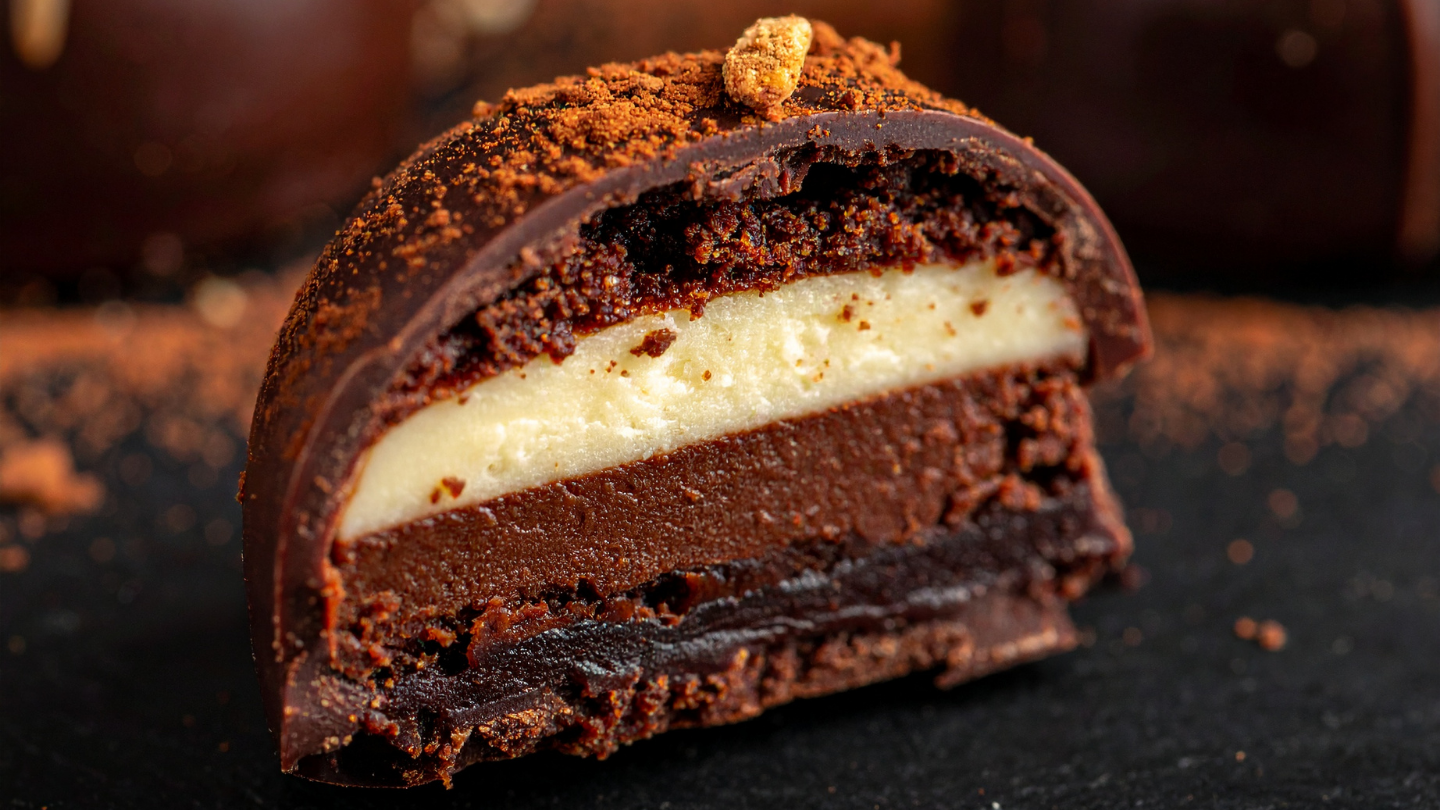
- Layered formats
- Filled structures
- Inclusion-heavy designs
4. Seasonal products are more exposed to value-driven decisions
Seasonal chocolate is often linked to gifting and premiumisation. That makes it more visible, and more scrutinised.
Consumers are paying closer attention to:
- Ingredient origin
- Cocoa sourcing
- Packaging materials
- Overall product positioning
This connects directly with the trend of active accountability, where sustainability and transparency are expected to be clear and credible.
(Source: Luker Chocolate, 2026 Top Chocolate Trends Report)
For seasonal SKUs, this means that packaging and ingredient choices are part of the product experience, not just supporting elements.
5. Indulgence and wellbeing are starting to overlap
Seasonal chocolate remains indulgent, but there is growing space for products that introduce some level of balance.
Examples include:
- Smaller portion formats
- No added sugar options
- Protein or fibre-enriched snacks
- More controlled sweetness profiles
This reflects the broader shift toward function-driven wellbeing, where consumers look for products that fit into their routines without removing indulgence entirely.
(Source: Luker Chocolate, 2026 Top Chocolate Trends Report)
This does not replace traditional seasonal products, but expands the range of viable concepts.
Key takeaway
Seasonal chocolate in 2026 is less about introducing new flavours and more about designing complete product experiences that align with how consumers use each occasion.
Shared pattern across marketsSeasonal chocolate in both the USA and the UK is built on a stable base and differentiated through experience. What they have in common:
Texture-related claims such as “crunchy” have grown +17% in confectionery (2022–2025), reinforcing its role in product differentiation. |
Planning seasonal chocolate: manufacturing and NPD implications of short production runs
Seasonal chocolate is developed under different constraints than core SKUs. Timelines are tighter, volumes are less predictable, and production runs are shorter. This changes how R&D and operations need to approach product design.
1. Short runs increase sensitivity to process variability
Seasonal SKUs often run in smaller batches, which reduces the margin for process stabilisation.
In practice, this means:
- Less time to adjust tempering curves
- Higher variability in viscosity and flow behaviour
- More frequent line changeovers
Products that perform well in pilot can behave differently when scaled into short industrial runs, especially when inclusions or fillings are involved.
2. Inclusion-heavy designs add operational complexity
Many seasonal products rely on inclusions or layered structures to create differentiation. These systems introduce additional variables during production.
Key pressure points:
- Inclusion dosing consistency
- Breakage during mixing or enrobing
- Sedimentation in low-viscosity systems
- Line stoppages due to irregular flow
From a manufacturing perspective, not all inclusions scale equally. Size, density, and fat content all affect performance.
3. Shelf life becomes more difficult to control
Seasonal products are often produced months before peak consumption, especially for Easter and Christmas.
This creates specific risks:
- Fat migration between fillings and shells
- Moisture transfer softening crispy components
- Texture degradation over time
- Flavour changes due to ingredient interactions
These effects are more pronounced in multi-component products, which are increasingly common in seasonal ranges.
4. Packaging and logistics are part of the formulation
Seasonal SKUs are more exposed to:
- Longer storage periods
- Varied distribution conditions
- Display requirements at point of sale
As a result, packaging needs to support:
- Barrier performance (moisture, oxygen, fat migration)
- Structural protection (especially for moulded or filled formats)
- Visual impact for seasonal positioning
Packaging decisions should be integrated early in development, not treated as a final step.
5. NPD timelines need to be front-loaded
Seasonal development works backwards from fixed commercial deadlines. Delays in early stages reduce flexibility later.
A typical constraint:
- Formulation decisions must be locked earlier than in core SKUs
- Fewer iterations are possible once scale-up begins
- Late-stage changes can disrupt production planning
This makes early validation more critical.
Recommended NPD approach for seasonal products
To manage these constraints, R&D and operations need a more structured approach:
Early stage
- Define texture and structure before finalising flavour
- Select inclusions based on process compatibility, not only sensory appeal
Pilot validation
- Test under real process conditions (not only lab scale)
- Evaluate flow, dosing, and stability
Pre-production
- Simulate short-run conditions
- Validate shelf life with final packaging
Final stage
- Align formulation with line capabilities and changeover constraints
Key takeaway
Seasonal chocolate development is not only about product design. It requires aligning formulation, process, and packaging early to ensure that products can perform under short production cycles and real distribution conditions.

How to translate seasonal insights into scalable chocolate products?
Seasonal products are used differently depending on the occasion and market. Defining the role early helps narrow technical decisions.
For example:
- Gifting → requires visual precision, structural stability, premium cues
- Self-treating → prioritises portioning, ease of consumption, flavour familiarity
- Sharing → benefits from modular formats, inclusions, and texture contrast
This definition guides format, structure, and packaging from the start.
Design texture as part of the system
Texture is one of the most consistent levers across seasonal launches, but it needs to be engineered, not added.
This involves:
- Selecting inclusions based on size, density, and fat interaction
- Defining how layers behave during processing and storage
- Anticipating changes over shelf life (loss of crunch, softening, migration)
Products that rely on texture contrast need validation beyond sensory testing, especially under distribution conditions.
Adapt flavour systems to each market
Flavour preferences differ not only in type, but in how they are combined.
A practical approach:
- Use dessert-inspired profiles (caramel, cream-based systems) for USA concepts
- Build on confectionery traditions (praline, nut, citrus) for UK applications
This avoids over-standardisation and improves product-market fit without requiring full reformulation of the base chocolate.
Work with a stable base and build complexity around it
Most seasonal products maintain a consistent chocolate base. Differentiation is achieved through structure.
This allows:
- Faster iteration across seasonal cycles
- Lower reformulation risk
- More predictable processing behaviour
Complexity is introduced through fillings, inclusions, and layering, not by changing the chocolate itself.
Validate under real conditions, not only in pilot
Many seasonal concepts perform well in controlled environments but face issues during scale-up or distribution.
Critical checks include:
- Flow behaviour during enrobing or moulding
- Inclusion, distribution, and integrity
- Shelf life under final packaging conditions
- Performance during short production runs
Early validation reduces the need for late-stage adjustments.
Key takeaway
Seasonal chocolate development in 2026 requires aligning market insight, product design, and manufacturing constraints from the start. Products that succeed are those that combine a clear role, controlled structure, and reliable performance at scale.
Seasonal concepts often start with an idea, but their success depends on how well they translate into a product that performs consistently.
At Luker Chocolate, we work closely with brands to develop chocolate applications that align with their product goals, from flavour and texture definition to processing performance and scalability.