





 New Product Development
 Custom Chocolate Formulations
 Quality Assurance

 Turnkey Chocolate Manufacturing
 Production at Scale
 Private Label
 Bakery and Pastry Solutions
 Organic Chocolate
 Upcycled Cocoa Products













|
Quick answer: The first B Corp certification asks a company one question: The gap between those two questions is where most of the real work happens. For a company that treated the first certification as a diagnostic, the second one is a test of whether sustainability has moved from an agenda into a management system that governance, operations, finance, and procurement all actually use. |
Luker Chocolate is going through recertification under B Lab's new standards and is one of the first 10 companies in Latin America to meet this rigorous global benchmark. We spoke to Catalina Gómez, our corporate sustainability lead, about what we’ve learnt so far and what the process is revealing about B Corp’s role in how a company is run, rather than simply how it presents itself.
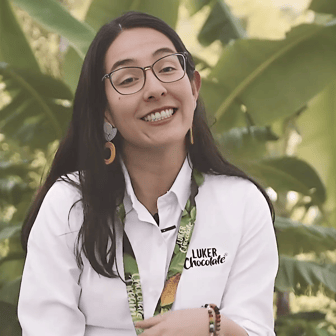
Table of contents:
-
What Changed Between the Old B Corp Assessment and the New Standards
-
Sustainability Should Not Operate As a Parallel Agenda to The Business
-
Evidence Over Information — The Shift from "We Have This" to "Here's How It's Managed"
- What B Corp Is Worth to Luker Beyond the Seal
What Changed Between the Old B Corp Assessment and the New Standards?
The previous B Impact Assessment worked on cumulative points. A company moved through 5 impact areas — governance, workers, community, environment, and customers — accumulating a score, and 80 points was the bar to clear.
The new standards replaced that logic. There are no points to accumulate. Instead, a company has to meet defined performance requirements across a broader and more specific set of impact topics: purpose and governance, fair work, justice, equity, diversity and inclusion, human rights, climate action, environmental stewardship and circularity, government affairs, and collective action that reflect today's sustainability landscape with a significant upgrade.
The difference matters more than it looks on paper. Under the old system, a company could ask: what practices do we have, and how many points do they earn us? Under the new one, the question is: how are these impacts structured, governed, managed, and evidenced? Policies, clear owners, resources, KPIs, risk management, and proof of implementation now sit at the centre of the assessment.
|
Before — B Impact Assessment |
Now — New B Corp Standards |
|---|---|
|
Scored across five impact areas; 80 points required |
Mandatory requirements, Pass/fail against performance requirements; no cumulative score across seven impact topics. |
|
Governance, workers, community, environment, customers |
Purpose and governance, fair work, JEDI, human rights, climate action, environmental stewardship and circularity, government affairs & collective action. |
|
Rewarded presence of practices |
Requires evidence of how practices are managed, by whom, with what resources |
|
Weighted towards performance already achieved |
Weighted towards management systems, due diligence, and a 5-year continuous improvement cycle. |
Going From an Initiative to a System in Recertification
The most immediate change recertification has forced on us is formalisation.
Under the old framework, having a strong initiative — a diversity programme, a supplier development project, an environmental commitment — could carry weight on its own. Under the new one, the initiative is the starting point, not the deliverable. What has to follow is documentation of how it's governed: who's accountable, what budget sits behind it, what risks it manages, how it's measured, and how it feeds back into decision-making.
"We've had to be far more specific about the system of commitment behind each thing we do," Catalina put it. "The new standards require greater formalization of policies, processes, and documentation, with clearly defined cross-functional responsibilities, approval mechanisms, and active participation across teams to ensure organizational ownership and accountability”
For Luker, this has meant making recertification a company-wide responsibility rather than a process led solely by the sustainability team. Talent, procurement, operations, finance, compliance, commercial, and corporate governance teams all now have a role in what used to be handled largely by one department.
💡Key Insight: The shift from "we have an initiative" to "we can show how it's managed, by whom, with what resources, and how we track it" is the shift that defines the new standards. Everything downstream of it — the documentation, the cross-functional involvement, the governance work — follows from that one reframing.
Sustainability Should Not Operate As a Parallel Agenda to The Business
One of the clearest things recertification makes visible is that sustainability can't operate as a parallel track to the business. It has to live inside the processes where decisions are actually made.
That sounds obvious until you try to prove it. The new standards don't take at face value that a company's sustainability work is integrated into its governance; they ask for the mechanisms. Where does sustainability show up in risk management? In the supplier selection criteria? In investment approvals? In talent development? How is operational performance reviewed?
For us, this has pulled sustainability into conversations it wasn't always part of — including some that happen well above the Sustainability team's line of sight. Procurement decisions are now evaluated against social and environmental supplier criteria that have to be documented and auditable. People policies are being structured around evidence of outcomes, not programme existence. Governance structures are being asked to show how impact considerations enter board-level and executive decisions.
Catalina's framing on this: "The aspiration is for sustainability to be in everything — in how the company makes decisions and in how it generates competitive value." Recertification is the mechanism forcing the gap between that aspiration and current practice to become measurable.
💡Actionable Tip for companies going through the same process: start by mapping which decisions in your business currently reference sustainability inputs and which don't. The gaps are usually where the evidence requirements of the new standards will land hardest. Sometimes gaps are opportunities rather than failures.
Evidence Over Information: from "We Have This" to "Here's How It's Managed"
The practical difference between the old and new assessments can be summarised in one sentence: it's no longer enough to describe what you do; you have to show how you do it.
Saying "we have a diversity programme" counts as information. Showing its scope, its outcomes, who's responsible, what tracking mechanisms exist, and how it has evolved — that counts as evidence. The new standards ask for the second thing. Plans need structure. Risks need owners. Budgets need to be visible. Implementation needs to be demonstrable.
That reframes the Sustainability team's role in a useful way. Less a repository of initiatives, more a coordinator of the evidence base being built across the organisation. The information doesn't live in Sustainability anymore. It lives in talent, procurement, operations, finance, compliance, commercial, and governance, and Sustainability's job is to make sure it can be surfaced, structured, and demonstrated when the assessment asks.
For a company that already had the underlying practices in place, this is work — but it's work that leaves the organisation measurably better run. Documentation discipline, clearer accountabilities, and cleaner data on social and environmental performance. These are useful outputs independently of whether B Corp asks for them.
💡Key Insight: The new standards reward companies whose sustainability work is already infrastructural, not performative. If the evidence is there to be collected, recertification formalises it. If it isn't, recertification exposes it.
What B Corp Is Worth to Luker Beyond the Seal
The temptation with any certification is to treat the badge as the outcome. The recertification process has made it clearer that the badge is the by-product. What B Corp is doing for us falls into four roles:
As an external standard, it lets us measure our management against an international reference point rather than only against our own history.
As a diagnostic tool, it surfaces gaps we might not have identified from the inside — practices we assumed were systematised that turned out to be concentrated in one person's inbox, metrics we thought were being tracked that weren't.
As a mechanism of organisational discipline, it forces commitments to become policies, policies to acquire owners, owners to be accountable for indicators, and indicators to generate evidence over time. That chain doesn't build itself.
As a transformation tool, it moves sustainability from a set of discrete initiatives into something closer to a management system — one that integrates with governance and continuous improvement rather than sitting alongside them.
👉 Catalina summarised it simply: "a way of measuring ourselves and knowing how we can improve." The seal is downstream of that work, not a substitute for it.
What This Round Is Showing Us About Where to Go Next
If our first certification established where we stood, and this recertification is testing the robustness of our systems, the next question is clear: how can we embed impact in our strategy and decision-making?
The priorities that have become clearer through this process:
- Deeper integration between sustainability and strategic planning
- Decisions grounded in a documented understanding of risks and impacts
- Stronger indicators across more areas of the business
- Clearer ownership from each function, not just from the Sustainability team
- Impact management that extends further along the value chain
- Value creation framed as mutual — for the business and for stakeholders
None of these are new ideas. What's new is that the new B Corp standards translate them into requirements with evidence attached, which changes how a company has to organise itself to meet them.
Recertification under the new B Lab Standards represents a significant achievement and reinforces our commitment to continuous improvement through rigor, transparency, accountability, and independently verified business practices. These higher standards strengthen our determination to lead by example, remain true to the values that have always guided the way we do business, and contribute to transforming the economy to benefit people, communities, and the planet.
💡Key takeaway: The honest version of what B Corp recertification does for a company isn't that it validates existing sustainability work. It restructures how that work is governed, documented, and connected to the rest of the business. The value lies in how the process strengthens governance, documentation, and decision-making, not simply in the certification itself.
Related resources:
Supply Chain Transparency in Chocolate: What "Verified" Really Means