




 New Product Development
 Custom Chocolate Formulations
 Quality Assurance
 Turnkey Chocolate Manufacturing
 Production at Scale
 Private Label
 Bakery and Pastry Solutions
 Organic Chocolate
 Upcycled Cocoa Products














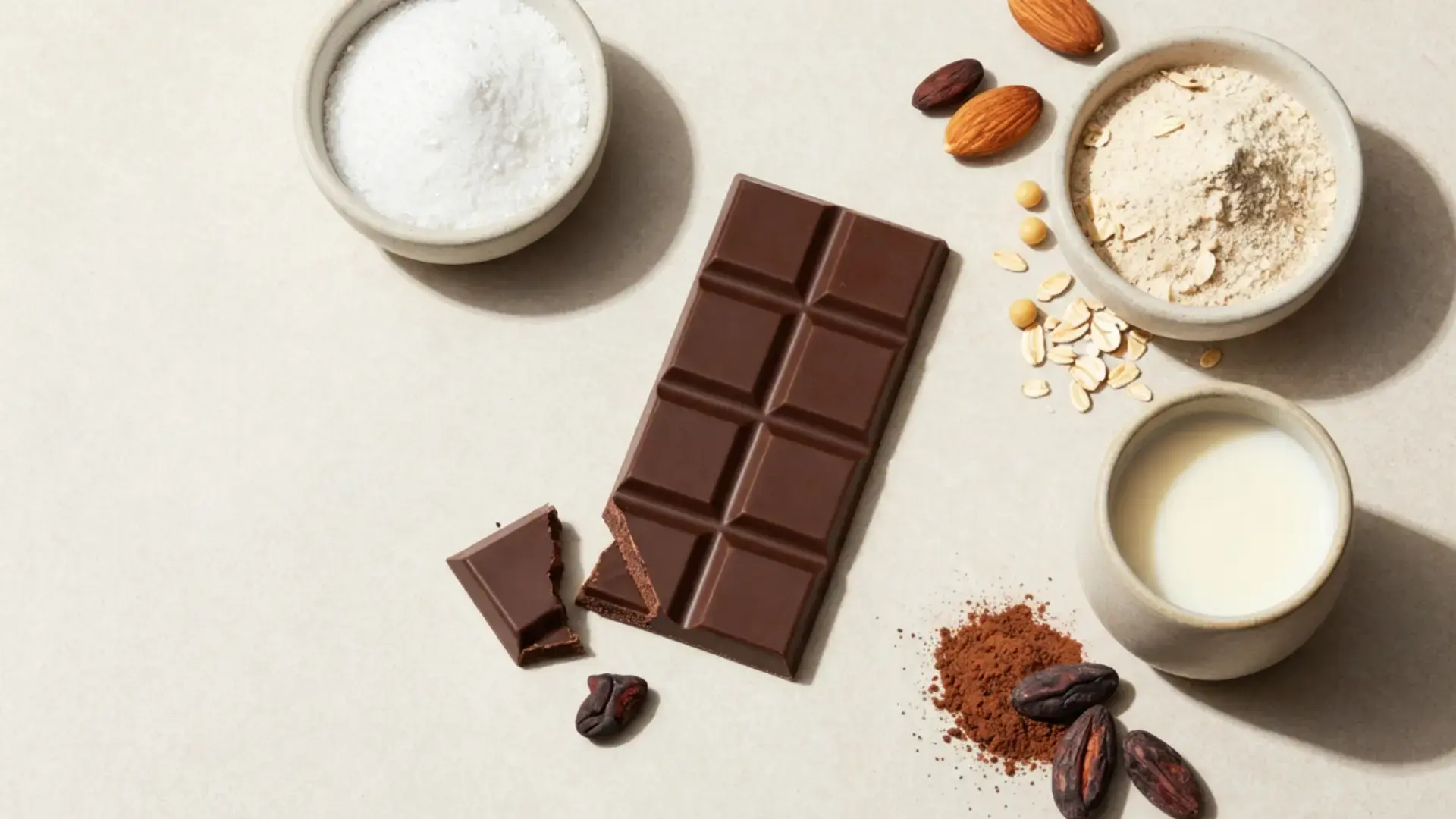
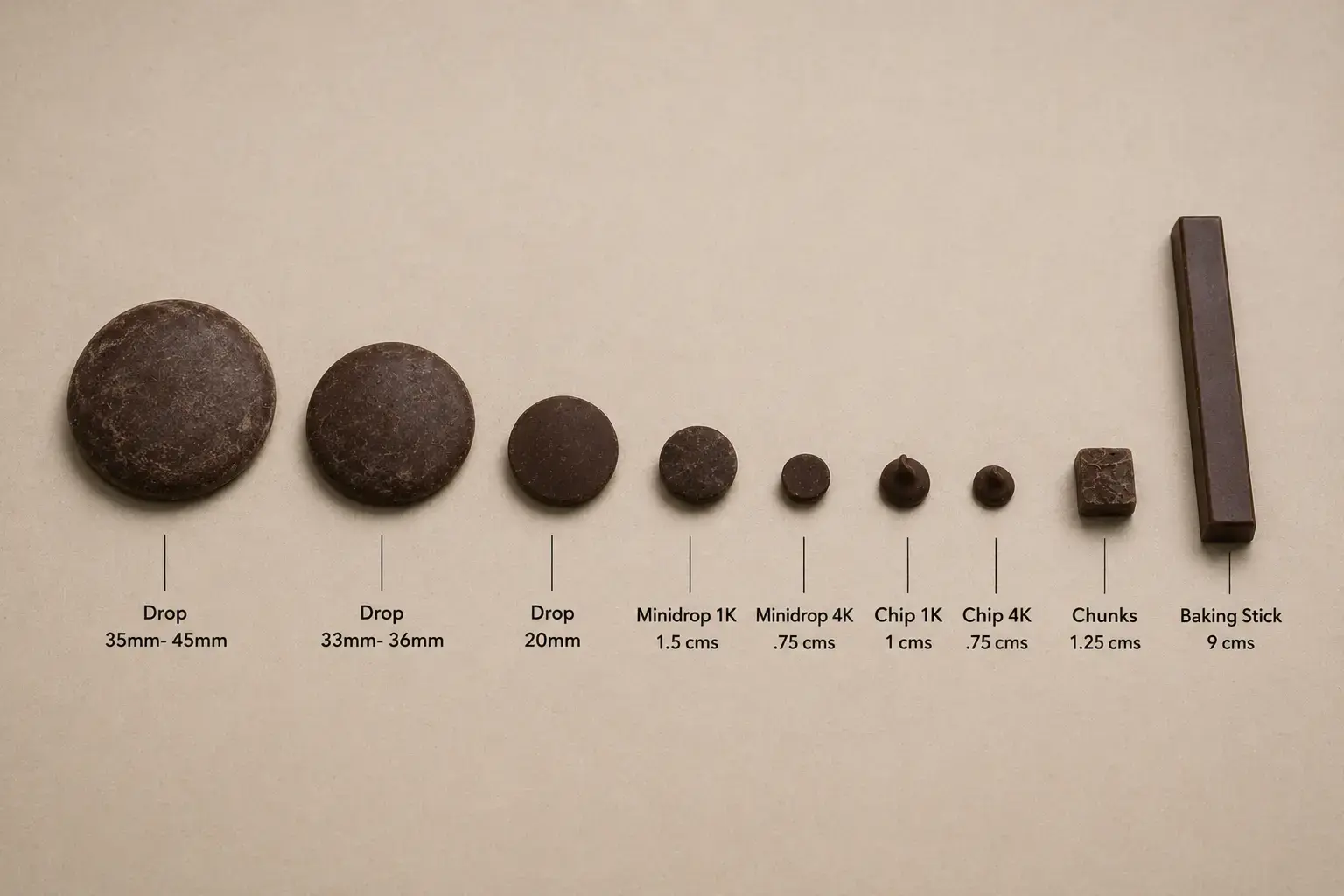
Drops, mini drops, chunks or batons: the format you specify quietly decides how your product doses, distributes, runs and keeps — long before the oven gets involved.
Does chocolate format really affect bakery production before baking begins?
Yes. The chocolate format you choose—whether standard drops, mini drops, chunks, batons or callets—determines melt behaviour, distribution, dosing accuracy, equipment compatibility and shelf-life stability before any dough reaches the oven. Chocolate format is a manufacturing and formulation decision, not simply a finishing detail.
In most product development projects, the chocolate format is treated as the final decision: first choose the chocolate, then perfect the recipe, and only then decide the format. In practice, the opposite is often true. Chocolate format is one of the earliest decisions affecting bakery production because the size and shape of each piece influence how it flows through feeders, distributes throughout a batter, performs in thin cross-sections, and maintains its integrity throughout production and distribution.
The same chocolate, even at the same cocoa percentage, can perform very differently depending on its format. That is why choosing the right chocolate format should involve R&D, production and procurement from the beginning—not just the recipe.
Why Piece Count Matters in Bakery Production
~4,000 vs. ~1,000 Pieces per Pound
At the same inclusion rate by weight, mini drops can deliver approximately 4,000 pieces per pound, compared with around 1,000 pieces per pound for standard drops. That means nearly four times as many chocolate inclusions from the same chocolate mass. Before the product even reaches the oven, the chocolate format has already changed distribution, appearance, and the eating experience.
What You'll Learn
- Why chocolate format is a manufacturing decision, not just a recipe detail
- When mini drops outperform standard drops—and when they don't
- How chocolate format affects dosing, depositing and bakery line efficiency
- Why batons are the preferred format for laminated and thin bakery products
- How chocolate format influences shelf-life stability and product performance
- A checklist for choosing the right chocolate format before production
1. How Chocolate Format Shapes Product Performance Before Baking
Bake stability is determined by more than shape alone—it depends on the fat system behind the chocolate format. Bake-stable chocolate is typically formulated with a fat system that limits flow during baking, often through a lower proportion of cocoa butter. As the chocolate melts, its higher viscosity helps it retain its shape while the surrounding dough sets. By contrast, chocolate designed for greater fluidity—such as couverture or chocolate cut into chunks—contains more cocoa butter, melts more readily and forms softer chocolate pools.
This is why two chocolate formats with the same cocoa percentage can perform very differently during baking. It also explains why the terminology on a specification sheet matters. Bake-stable and ideal for baking describe different performance characteristics. A bake-stable chocolate is engineered to retain its shape throughout baking, whereas chocolate described as ideal for baking performs well in baked applications but is expected to soften or melt. Identifying the performance your application requires should be one of the first decisions in product development.
|
Chocolate Format |
Typical Bake Performance |
Best Applications |
Risk if mis-specified |
|
Standard drops |
Hold shape when bake-stable; soften if higher in cocoa butter |
Cookies, muffins, batters with good suspension |
Sinking in thin batters; fewer contact points |
|
Mini drops |
Hold shape; very high piece count |
Thin cookies, bars, even-distribution batters |
Lower visual impact per piece |
|
Chunks |
Larger footprint; tend to soften into richer pools |
Premium, rustic, visibly indulgent products |
Uneven distribution; sinking; dosing variance |
|
Batons |
Bake-stable, low fluidity, hold a defined strip |
Laminated viennoiserie, filled formats |
Wrong geometry for batters and inclusions |
|
Callets / discs |
Melt quickly and evenly |
Melting, coating, ganache, tempering |
Not designed to survive as an inclusion |
💡Key insight:
Chocolate format is more than a choice of shape—it reflects the fat system that determines how chocolate performs during baking. Defining whether the chocolate should retain its shape or melt into the product matrix is one of the earliest decisions in bakery product development.
Actionable Tips 👇
- Ask your supplier about the fat system, thermal tolerance and cocoa butter content—not just the cocoa percentage.
- Define early whether your application requires bake-stable chocolate or chocolate designed to melt during baking.
- Validate chocolate performance under your actual production conditions, not just bench-scale testing.
2. Standard drops vs mini drops: When Mini Drops Outperform Standard Drops
The difference between standard drops and mini drops is not simply size—it is piece count and distribution. Because mini drops provide significantly more pieces at the same inclusion rate by weight, they distribute more evenly throughout the dough, remain suspended more effectively and are less likely to sink in lighter batters. Pieces measuring approximately 2–3 mm are increasingly used in cereal bars, granola clusters and breakfast biscuits, where even distribution and bake performance are critical to product quality.
Standard drops and chunks deliver a different advantage: visual impact. Larger pieces create more defined chocolate pockets and a stronger perception of indulgence, making chunks a popular choice for premium and rustic-style bakery products. Choosing between standard drops and mini drops is ultimately a balance between visual impact and distribution. The right format depends on the product experience you want to deliver.
|
Performance Factor |
Standard drops |
Mini drops |
|
Pieces per unit weight |
Lower (~1,000 / lb) |
Higher (~4,000 / lb) |
|
Spatial distribution |
Larger, defined pockets |
Even and frequent |
|
Suspension in batter |
More prone to sinking |
Stays suspended more readily |
|
Visual impact per piece |
High |
Low |
|
Suited to thin cross-sections |
Limited |
Strong |
|
Supports a "Chocolate in Every Bite" claim |
Weaker |
Stronger |
💡Key insight:
The best chocolate format depends on the product objective. Mini drops maximise distribution and consistency, while standard drops and chunks deliver greater visual impact and more defined chocolate pockets.
Actionable Tips 👇
- Evaluate piece count per portion, not just the total chocolate weight.
- For lighter batters, consider smaller chocolate formats before adjusting the formulation.
- Match chocolate format to product thickness, application and the desired eating experience.
3. How Chocolate Format Affects Dosing, Depositing and Bakery Line Efficiency
Chocolate format influences manufacturing long before baking begins. The size and shape of each chocolate piece determine which production technologies are suitable for your application and how efficiently your bakery line operates. Chocolate inclusions that are too large or irregular can block depositing nozzles, affect dosing accuracy and limit the production methods available. This is why products containing chocolate inclusions are commonly produced using wire-cutting or rotary moulding rather than piston depositing.
Flow characteristics are equally important. Inclusion feeders require chocolate pieces that remain discrete, flow freely and resist clumping or bridging within the hopper. Poor flow behaviour can lead to uneven dosing, production interruptions and inconsistent product quality. Modern depositing systems can accommodate doughs containing chocolate inclusions, but the chocolate format must be compatible with the equipment, changeover procedures and cleaning requirements. On dedicated depositing lines, piece sizes typically range from 2 to 18 mm, but the selected format must always match the capabilities of the production line.
|
Chocolate Format |
Compatible Manufacturing Process |
Flow & Feeder considerations |
Potential Operational risk |
|
Drops & mini drops |
Wire-cut, rotary mould, inclusion feeders |
Free-flowing, no clumping |
Nozzle blockage if piston-deposited |
|
Chunks |
Wire-cut, dosed feeders, hand-scaled batches |
Irregular size affects dosing accuracy |
Bridging in hoppers; weight variance |
|
Batons |
Manual or automated lay-down on laminated sheet |
Prone to breakage in handling and transit |
Misalignment during rolling |
💡Key insight:
Chocolate format is a manufacturing decision as much as a product development decision. Selecting the right format improves dosing accuracy, production efficiency and line compatibility before baking even begins.
Actionable Tips 👇
- Confirm that the selected chocolate format is compatible with your existing manufacturing and depositing equipment
- Validate flow behaviour under your actual production conditions to minimise clumping and dosing variability.
- Involve R&D, production and procurement early to select the most suitable chocolate format for your bakery line.
4. Why Batons Are the Best Choice for Laminated and Thin Bakery Products
In thin bakery products, chocolate format becomes a question of geometry. When a chocolate piece approaches or exceeds the thickness of the product, it stops behaving as an inclusion and begins affecting product structure. Pieces that are too large can break through the surface, disrupt the eating experience or create uneven baking. As products become thinner, chocolate pieces generally need to become smaller and more numerous to maintain consistent performance.
Laminated bakery products are one of the clearest examples of this principle. Batons create a continuous strip of chocolate through the centre of the pastry, allowing for consistent placement and helping maintain alignment as the dough is rolled. Individual drops can also be used, but they require greater positioning accuracy during production. Like other bake-stable chocolate formats, batons are formulated with a low-fluidity fat system that helps them retain their shape during baking. They are designed to withstand oven temperatures of up to approximately 200 °C while maintaining their intended structure. The classic pain au chocolat demonstrates how chocolate format influences manufacturing performance as much as the finished product itself.
Recommended Chocolate Formats by Application
🥐 Laminated Viennoiserie
Applications: Pain au chocolat, chocolate croissants, filled Danish pastries
Recommended format: Batons
A continuous chocolate strip supports clean lamination, predictable placement and more efficient shaping. While drops can also be used, they are more difficult to position consistently as laminated dough is rolled.
🍪 Thin & Rotary-Moulded Biscuits and Wafers
Applications: Thin cookies, sandwich biscuit bases, wafer layers
Recommended format: Mini Drops
Mini drops distribute evenly within thin cross-sections, helping maintain a smooth surface, reduce poke-through and preserve product texture. Larger drops may dominate the cross-section or distort the final bake.
🍫 Filled & Enrobed Thin Products
Applications: Thin coatings, filled bars, layered products
Recommended approach: Control chocolate layer thickness and fat migration carefully. In very thin chocolate layers, fat migration between the filling and the chocolate becomes more significant, making it essential to match both the chocolate format and the fat system to the application.
💡Key insight:
In thin and laminated bakery products, geometry is just as important as formulation. Matching chocolate format to the product's cross-section improves manufacturing consistency, bake performance and product quality.
Actionable Tips 👇
- Keep chocolate pieces well below the thickness of the product's cross-section whenever possible.
- Use batons as the preferred chocolate format for laminated bakery products unless a specific visual effect requires another format.
- Validate chocolate format under actual production conditions rather than relying on thicker reference products or bench-scale trials.
5. How Chocolate Format Influences Shelf-Life Stability
Chocolate format continues to influence product performance long after baking is complete. The size, shape and surface area of each chocolate piece affect how the finished product performs throughout its shelf life. In multi-component bakery products, fat migration can lead to fat bloom—the whitish surface appearance caused by cocoa butter recrystallisation. Warm transport conditions, packaging interactions and storage temperatures can accelerate this process. Although fat bloom is an aesthetic issue rather than a food safety concern, it is often perceived by consumers as a product defect.
Moisture migration also plays an important role in shelf-life stability. Moisture exchange between chocolate inclusions and the surrounding crumb can cause clumping in dry mixes, affect leavening performance and reduce the crisp texture that defines many bakery products. While smaller chocolate pieces improve distribution, they also expose more surface area, increasing the potential for moisture and fat migration. This makes chocolate format a balance between product appearance, eating quality and long-term stability. Where these risks are significant, moisture barriers or fat-coated chocolate pieces can help preserve texture, appearance and product quality throughout the intended shelf life.
💡Key insight:
Chocolate format affects more than bake performance. The format selected during product development must also withstand transport, storage, and shelf-life conditions to preserve product quality over time.
Actionable Tips 👇
- Balance the improved distribution of smaller chocolate pieces against their greater exposed surface area and increased potential for fat and moisture migration.
- Consider moisture barriers or fat-coated chocolate pieces when products are exposed to demanding transport, storage or packaging conditions.
- Validate chocolate format under real transport, storage and shelf-life conditions—not only during production trials.
6. A Checklist for Choosing the Right Chocolate Format Before Production
Before finalising your chocolate format, ask the following questions:
| Should the chocolate retain its shape during baking or melt into the product matrix? |
| Is the piece size appropriate for both the product's cross-section and your manufacturing equipment? |
| Have you evaluated piece count per portion, not just the total inclusion weight? |
| Is the selected chocolate format compatible with your dosing, depositing and feeding systems? |
| Are batons the most suitable format for laminated or thin bakery applications? |
| Have you considered shelf life, transport and storage conditions when selecting the format? |
| Has the chocolate format been validated under actual production and storage conditions rather than bench-scale trials? |
Selecting a chocolate format based only on appearance overlooks its broader impact on manufacturing and product performance. The format chosen during product development influences dosing accuracy, distribution, equipment compatibility, behaviour in thin and laminated products, and shelf-life stability. Making the right decision early helps reduce reformulation, improves manufacturing efficiency and supports more consistent product quality throughout production.
Choosing the Right Chocolate Format Is a Cross-Functional Decision
The most successful chocolate format decisions are made through collaboration between R&D, production and procurement. The right format must perform consistently during formulation, manufacturing and throughout the finished product's shelf life. Bringing these teams together early helps reduce development time, minimise production challenges and achieve more reliable product performance.